
When a hidden leak is an emergency
Some leaks can wait for a morning appointment and some cannot. Water running down a wall, a ceiling that bulges, water pooling at the meter box, or a floor wet from no obvious source all need attention now. Inside a wall cavity, water can reach wiring and subfloor before you see more than a damp spot.
Call our emergency line any time, including nights and weekends. Same-day appointments are offered when available. If you smell gas, leave the building and call the gas utility or 911 from outside.
What to do while you wait
These steps limit damage and give the plumber a head start.
Shut off the main valve
Usually where the line enters the house, often in a basement or crawl space. Close it fully, then open one low faucet.
Switch off power near water
If water is near outlets or a ceiling fixture, turn off that breaker from a dry spot.
Read and photograph the meter
Note the dial or digits with the house valve closed. If the meter still moves, the leak is between the meter and your house.
Move belongings and catch drips
Lift rugs and electronics off wet floors, and set a bucket under ceiling drips.
Document everything
Take dated photos of stains and the meter. Insurers usually ask for them.
Why leaks hide in Zionsville homes
Water supply pipes run through walls, ceilings, crawl spaces and slabs, so most leaks start out of sight. In Zionsville the winters add stress. NWS Indianapolis lists a January average low of 20.9 F as a 1991-2020 normal, and the city's record low is -27 F. Lines in exterior walls, garages and crawl spaces can crack when they freeze.
A pipe cracked by a cold snap often drips slowly after the thaw instead of bursting, so a stain can show up weeks later. Indianapolis averages 43.63 inches of precipitation a year per NWS, so a ceiling stain may be roof water, not plumbing.
Leak Detection problem right now?
Call the 24/7 line. Tell us what you see, and we will tell you what to do first and what a visit involves.
Signs of a hidden water leak
Most leaks announce themselves quietly. These are the patterns we hear about most.
Meter moves with everything off
If every fixture is closed and the dial or digits still change, water is escaping somewhere in the system.
Water bill climbing
A slow rise over several billing cycles, with no change in use, often points to a small continuous leak.
Warm spot on the floor
A patch of floor that stays warm can mean a hot water line leaking under the slab.
Stains, bubbling paint or musty smell
Brown rings, peeling paint, soft drywall or a damp odor all suggest moisture behind the surface.
Low pressure or soggy yard
A drop in pressure, or a lawn patch that stays wet and green in dry weather, can mark a buried line leak.
Meter running or water bill too high
Start with the meter, because it is the quickest honest test. EPA WaterSense advises reading the meter, using no water for two hours, and reading it again. If the reading changed, you probably have a leak.
EPA says the average household wastes over 9,300 gallons a year to leaks, and a family of four using more than 12,000 gallons in a winter month may have serious ones. The Indiana OUCC says a drip per second wastes roughly 260 gallons a month.
Rule out cheap suspects first, such as toilet flappers. Add food coloring to the tank, wait 15 to 20 minutes without flushing, and look for color in the bowl. If the meter still runs after faucets and hose bibs are ruled out, the leak is in a hidden pipe. A leaking toilet can be fixed on the same visit.
Ceiling and wall leaks
A stain on a ceiling or wall is only where the water ended up, not where it started. Water follows framing, pipes and wiring, and it can travel several feet before it shows. A drip under a bathroom often comes from a supply line, a shower valve or a drain joint in the floor above.
A moisture meter maps the wet area, then listening gear and a thermal camera narrow the source, since hot lines can show warmer on a thermal image. A pressure test on the suspect line confirms it. We then cut the smallest access hole that reaches the pipe, which keeps drywall repair modest.
A stain that grows only after rain points to the roof, which is a roofer's job. One that grows on dry days points to plumbing. If a ceiling bulges with water, a small hole at the lowest point over a bucket can release it before it collapses.
Under-house and crawlspace leaks
Crawl spaces hide leaks well. A supply line sags and drips onto soil, a drain joint weeps, or a water heater valve seeps for months. Signs include soft or stained subfloor, a musty smell in the rooms above, mold on joists, and a meter that runs when nothing is on.
We check exposed pipes, hangers, joints and shutoff valves, then pressure test the lines. Pipes in an unheated crawl space are also the ones that freeze, so a cracked section gets repaired and we talk through insulation. Our burst pipe repair page covers what happens when one has split outright.
A crawl space that stays damp with no pipe leak is a drainage question. Our basement waterproofing and sump pump pages cover those options.
Buried water line leaks
The line from the meter to your house runs underground, so a leak may show only as a soft lawn patch, a pressure drop or an odd bill. The Indiana OUCC says an unusually high bill can point to a leak in the underground supply line, which is typically the customer's responsibility between the meter and the building.
To confirm, close the house valve and watch the meter. If it moves, the leak is outside the house. Listening gear and a pipe locator pinpoint the break, so the trench is short. Repair and replacement options are on our water line repair page.
Before any digging, call Indiana 811. Notice must reach them at least two full working days before digging and no more than ten calendar days before, and a ticket expires after 20 days.
Slab leaks
We do not have a separate slab leak page, so this section covers it in full. A slab leak is a leak in a water line under or inside the concrete floor. Hot lines are common suspects because heat speeds corrosion, and a warm floor spot is the classic clue.
Other signs include running-water sounds with everything off, a meter that keeps turning, and wet or lifting flooring. Drain leaks under a slab behave differently, causing odors or damp spots rather than a pressure drop.
We isolate the line by closing sections and watching the meter, then listen on the floor for the escaping water. A thermal camera helps when a hot line is leaking. Once located, the options are a spot repair through a small opening in the slab, rerouting the line through walls or attic, or repiping the run. Repiping the run can make sense if the same line keeps failing.
Irrigation, pool, spa and yard leaks
Irrigation leaks hide because the lines are buried. A soggy zone, weak heads or a bill spike in watering season is the usual clue, and valve boxes, broken heads and cracked fittings are the common failures. Winterizing before the first freeze matters, and NWS Indianapolis lists October 26 as the average first freeze.
Pool and spa levels also drop from evaporation, so a bucket test helps show whether the pool loses more than that. If it does, the leak may be in a skimmer line, return line or fitting. We locate plumbing leaks, but we do not repair pool shells, liners or equipment.
Yard and meter box leaks show as a wet spot or water standing in the meter box. Check whether the box is full with all water off at the house. If it is, the leak is on the supply side. Who fixes it depends on which side of the meter the break is on, so ask your water utility, whose contact details are on your bill.
How we find the leak
We work from the cheapest test to the most invasive. Closing the house valve and watching the meter places the leak inside or outside the house, and closing branches such as the water heater or irrigation narrows it further.
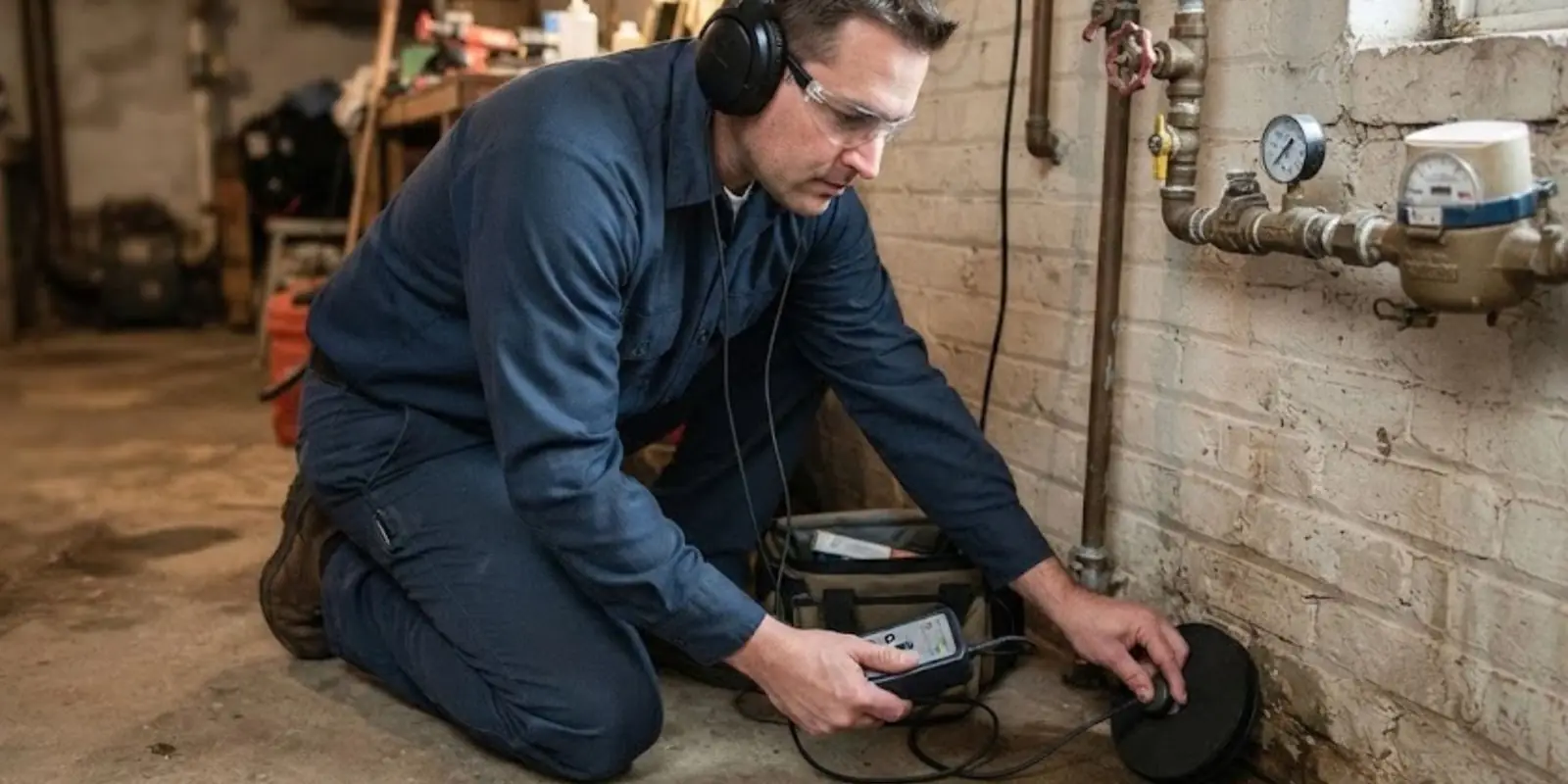
Listening gear picks up the sound of water escaping a pressurized pipe. A moisture meter and thermal camera map where the wet area is, and a pressure test confirms whether a line holds. For drain leaks, a camera on the line shows cracks or open joints. We only open a wall, floor or trench once the evidence points to one spot.
Repair options once the leak is found
The right fix depends on where the pipe is and how many problems it has.
| Situation | Likely repair | Trade-off |
|---|---|---|
| Pinhole in accessible copper | Cut out and replace the section | Quick, but other spots may follow if the pipe is corroded |
| Buried line with one break | Spot excavation and repair | Lawn, driveway or landscaping is disturbed along the trench |
| Slab leak on one line | Reroute through walls or attic | Avoids breaking concrete, more work in the walls |
| Repeated leaks on an old line | Repipe the run or house | Higher cost now, fewer repeat failures later |
We will tell you if a repair is not worth doing and replacement makes more sense.
What affects the price of leak detection and repair
Leak work varies widely, so these factors decide the number.
Where the leak is
A leak under a sink is a short job. One under a slab or in a yard takes more tools and time.
Access
Open crawl space pipes cost less to reach than lines behind finished walls or under flooring.
Pipe material and age
Copper, PEX, galvanized and CPVC repair differently, and old pipe may fail again nearby.
Restoration after the repair
Opening a wall or trench leaves patching, flooring or landscaping that is usually a separate cost.
Standard homeowner policies usually cover sudden and accidental water damage, such as a burst pipe, and usually do not cover gradual leaks, wear or the failed part itself. Check your policy and ask your agent before work starts.
Call us for a clear price for your house before work starts.
Call (317) 740-1302Leak detection in Zionsville and Whitestown
Our licensed and insured plumbers serve Zionsville and nearby towns, including neighboring Whitestown. You can check any plumber on the state's online license verification, which covers plumbing contractors and journeymen.
Locate your main shutoff and your meter before a leak starts, and test both once a year. If the leak turns out to be a tank, see water heater repair. Permit rules vary, so ask the Zionsville Planning & Building Department about any pipe replacement. We find and fix plumbing leaks, and we do not repair roofs or remove mold.
Frequently asked questions
Yes. Our emergency line is open 24/7, including nights, weekends and holidays. Same-day appointments are available when the schedule allows, and we do not promise an arrival time.
Close the main valve while you wait if water is actively showing, switch off power near wet areas, and photograph the meter.
Read your meter, use no water for two hours, then read it again. EPA WaterSense says a change means you probably have a leak.
If the meter holds still, the bill may reflect habits, seasonal use or a billing issue. Your water utility can explain the account.
A meter test, listening gear, a moisture meter, a thermal camera and pressure tests narrow the source before any cutting. Drain leaks can be checked with a camera.
The aim is one small opening, placed on evidence.
Yes. We isolate lines, watch the meter, and use listening gear on the floor to place the leak. A warm floor spot is a strong clue for a hot line.
Options include a spot repair, rerouting the line or repiping, and we explain each before work.
The Indiana OUCC says the underground line is typically the customer's responsibility. The utility's side of the meter is different, so ask your water utility.
If digging is needed, call Indiana 811 first.
It depends on your policy. Sudden and accidental water damage is usually covered, while gradual leaks and the failed part usually are not. Check your policy and ask your agent.
Use the Indiana Professional Licensing Agency's online license verification. Plumbing contractors and journeymen are licensed there, and acting without a license is unlawful per the PLA.
Sources
Figures and guidelines on this page are taken from these public sources. Local rules and utility details can change, so check the source before you rely on a number.
- meter test, leak statistics (Federal agency)
- underground line, 260 gallons (State of Indiana)
- NWS normals and first freeze (Federal agency)
- 811 timing (State of Indiana)