
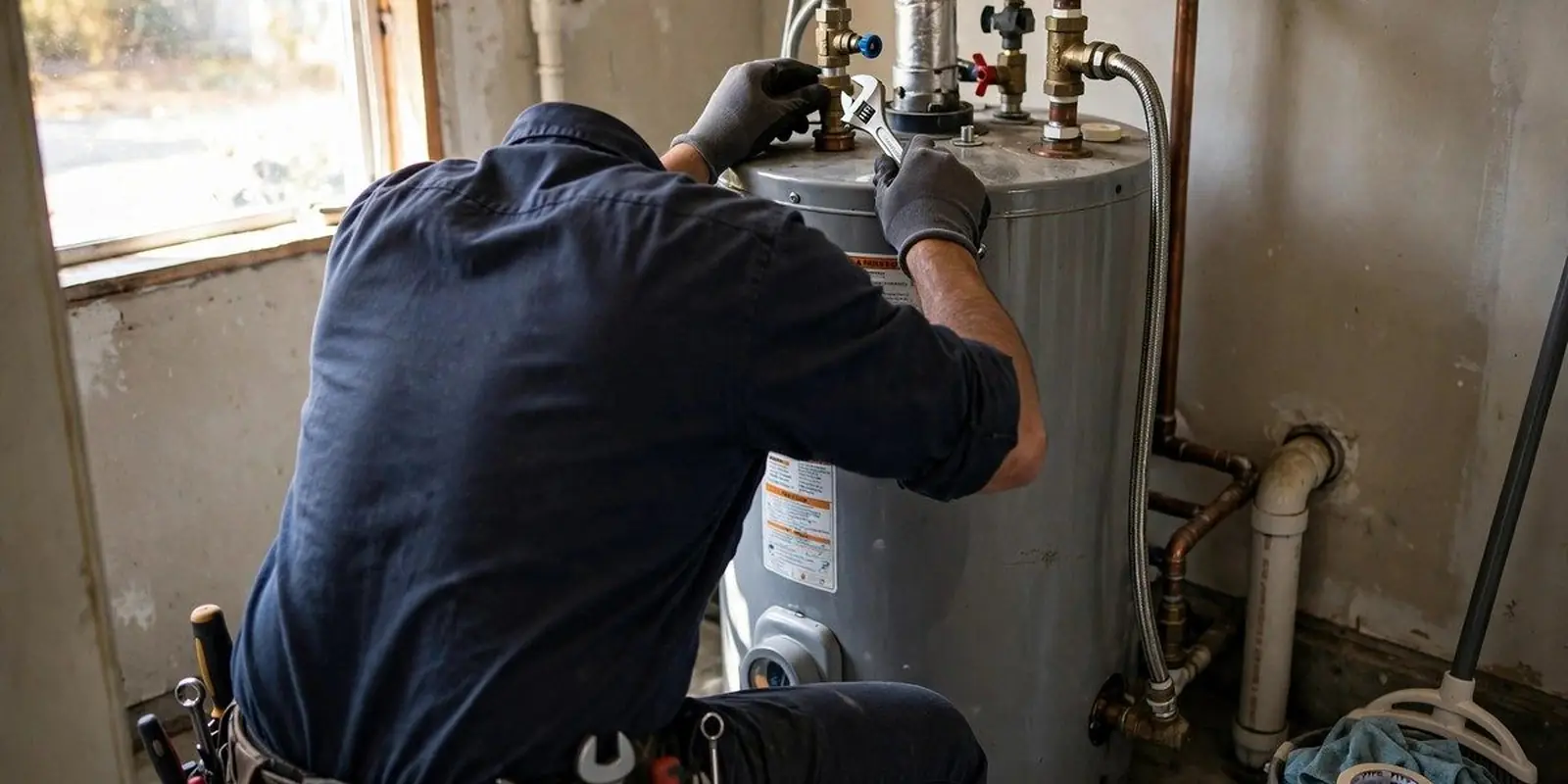
When a leaking water heater is an emergency
A tank holds 40 or 50 gallons in most homes, and a failed tank can release all of it onto the floor within an hour or so. Water that is steaming, spraying from the top, or spreading toward a finished basement, a furnace or an electrical panel needs action right now. A slow drip from a pipe fitting is less urgent, but it still gets worse.
A gas smell is a different matter. Leave the house, then call the gas utility or 911 from outside. Do not flip switches or relight anything on the way out.
What to do while you wait
These steps take about five minutes and limit the damage before a plumber reaches you.
Cut the energy
For an electric tank, turn off its breaker. For gas, turn the control dial to OFF or close the gas valve on the supply pipe. Never leave an element powered in an empty tank, because it burns out in minutes.
Close the cold supply
Turn the valve on the cold pipe above the tank clockwise until it stops. If it will not move, close the main shutoff where the line enters the house.
Contain the water
Move boxes off the floor, lay towels, and use a wet vacuum if you own one. Open a hot tap upstairs so the lines drain and the pressure drops.
Document before cleanup
Take photos of the tank, the data label and the wet area. Your insurance agent will ask for them, and a ruined tank is easier to price when the model number is visible.
Leave the drain valve alone
Draining a full tank onto a finished floor makes the mess bigger. Wait for us unless you can run a hose to a floor drain.
Signs your water heater needs repair
Each symptom below points toward a different part, which is why guessing at a replacement is expensive.
Water at the base
Check whether it comes from the tank body, the top fittings or the relief valve pipe. Only a leaking tank wall is a replacement. Everything else is usually a repair.
Hot water runs out fast
On an electric unit this often means a dead lower element. On gas it can mean a thick layer of sediment on the tank floor.
Lukewarm water only
A bad thermostat, a tripped high-limit switch or a weak gas burner can each hold the temperature below where it should sit.
Rumbling or popping
Water trapped under hardened sediment boils and bursts through it. The noise is a flush job, not a sign the tank is about to fail.
Rusty or metallic hot water
If only the hot side runs rusty, the tank lining or anode rod is wearing out. Cold water that runs rusty too points at the pipes.
Pilot will not stay lit
A worn thermocouple, a dirty pilot tube or a draft problem are the usual causes on older gas models.
Rotten egg smell
Bacteria feeding on a worn anode rod can make hot water smell of sulfur. It is a nuisance, not a hazard, and a new rod often cures it.
Water Heater Repair problem right now?
Call the 24/7 line. Tell us what you see, and we will tell you what to do first and what a visit involves.
Where the leak is coming from decides the repair
Three places account for most wet floors. The first is the connections on top, where flex lines or copper stubs meet the tank. A loose union or a worn gasket is a short job. The second is the temperature and pressure relief valve, which is built to open at 150 psi or 210 degrees F. A valve that drips constantly may be tired, or reacting to excess pressure.
The third place is the tank itself. Steel tanks rust from the inside, and once the lining fails, water seeps through the seam and runs down the jacket. That leak cannot be patched, and we will say so rather than sell a repair that will not last. If it is the tank, our water heater replacement page explains what comes next.
How we find the failed part
We start by drying the tank and wrapping a dry paper towel around each fitting, which shows a seep better than eyes alone. A digital multimeter checks both heating elements and the thermostats on an electric unit, since a good element reads a specific resistance and a burnt one reads open. On gas, we measure thermocouple output and look at the burner flame and flue draft.
A pressure gauge on a hose bib tells us the house water pressure. Municipal supply above about 80 psi stresses every fixture in the house, and it can open a relief valve that is otherwise healthy. We also check whether a closed-loop system lacks an expansion tank, because heated water has nowhere to go and the valve takes the blame.
No hot water, and what usually causes it
Start with the simple checks. On electric models, look at the breaker and press the red reset button on the upper thermostat behind the access panel (power off first). On gas, check that the pilot is lit and the gas valve is open. If neither explains it, the fault is inside the unit.
Electric tanks carry two elements, usually 4,500 watts at 240 volts, and one failing gives you hot water for a short time only. A gas unit that lights and then drops out often has a bad thermocouple. A modern unit with an igniter may show a blinking light code, and the pattern in the owner's manual narrows the cause before we open anything.
Repairing electric, gas and hybrid heaters
The fault list changes with the energy source, so the repair does too.
Electric and hybrid (heat pump)
- Conventional electric: failed elements, thermostats and high-limit switches are the common parts
- Hybrid models add a compressor, a fan and an air filter that clogs and trips an error
- A hybrid needs open air around it, and a closed closet starves the heat pump of warmth
- Condensate drain lines on hybrids can clog and overflow onto the floor
Gas
- Pilot assemblies, thermocouples and igniters wear out first
- A gas control valve is a costlier part, so a repair has to be weighed against the age of the tank
- Flue and draft trouble can cause backdrafting, so we check venting on every gas call
- Burner ports can foul with dust and sediment, and a yellow flame points at that
Noise, sediment and routine upkeep
Sediment settles at the bottom of every tank, and the more minerals in your supply, the faster it builds. Ask your water utility for its annual water quality report, or test your tap with a store-bought kit. Citizens' Indianapolis-area water is hard, and the Town's utilities page lists Citizens Water contact numbers, so your own bill is the place to confirm who serves your address.
A yearly flush through the drain valve clears loose scale, and it keeps the burner or lower element working in clean water instead of buried in crust. The anode rod is a magnesium or aluminum rod that rusts so the tank does not, so check it every few years. A flush on a tank never serviced in ten years can start leaks at the drain valve, and we will say when to leave one alone.
Repair or replace, a quick guide
DOE lists storage tank water heaters at 10 to 15 years of service life. Age is one input, and the failed part is the other.
| Situation | Usual call | Why |
|---|---|---|
| Tank under 8 years, bad element or thermostat | Repair | The tank is sound and the part is cheap relative to a new unit |
| Leak at a top fitting or relief valve | Repair | The tank wall is dry, so the leak is in an attached part |
| Tank 12 years or older with a failed gas valve | Often replace | The part cost approaches the value of a unit near the end of its life |
| Water seeping from the tank seam or bottom | Replace | Rust has gone through the lining and cannot be patched |
| Repeated repairs within a year | Replace | Wear is spreading through several parts at once |
If a leaking tank is on its way out, our installation page lays out what a planned swap involves, so you can decide without being rushed.
Service, flushing and error codes
Many calls are maintenance, not breakdowns. A service visit means flushing the tank, testing the relief valve, checking the anode rod and looking over venting and gas connections. A blinking error code on a newer unit is the heater reporting which sensor or ignition step failed, and the manual lists what each pattern means.
What affects the price of water heater repair
Repair prices run from a small valve job to a gas control valve, so a number over the phone without seeing the unit would be a guess.
The failed part
A relief valve, an element and a gas control valve differ in cost, and some models need a part ordered.
Fuel type and model
Hybrid and power-vent models carry costlier components than a basic electric tank.
Access
A unit in a tight utility closet or a finished basement takes longer to reach and work around.
Age and condition
On an older tank, we may recommend against a part that will not outlast the next failure.
After-hours timing
Night, weekend and holiday calls can price differently from a scheduled visit, and we tell you before work starts.
Homeowner policies usually cover sudden and accidental water damage, such as a tank bursting. They usually exclude slow leaks, wear and the failed heater itself. Check your policy and ask your agent.
Read us the model off the data label and describe what you see, and you get a clear price before work starts.
Call (317) 740-1302Water heater repair in Zionsville homes
Zionsville is a Boone County town of about 33,600 people, and the Census Bureau puts the owner-occupied rate at 84.2 percent. Owners make the repair call themselves, and with a median home value of $587,800, a flooded finished basement costs far more than the tank.
Winter makes it sharper. The January average low in Indianapolis is 20.9 F, and incoming water is cold, so the heater works hardest when a breakdown hurts most. We also serve nearby Whitestown and the towns around it. Before hiring any plumber, you can confirm the license through the Indiana Professional Licensing Agency's free lookup. We are licensed and insured, and we will tell you when a tank is beyond repair.
Frequently asked questions
Yes. Our emergency line runs 24/7, and same-day appointments are offered when available. Call, describe what you see, and we tell you the next step. We do not promise an arrival time, but we start you on shutoff steps right away.
Check the drain valve first, since it can seep when it is worn or the cap is loose. If the water comes from the tank itself, the lining has rusted through and the tank must be replaced.
Condensation on a gas unit can mimic a leak, so dry the base and watch it for an hour.
On electric models, it is usually a tripped breaker, a reset button or a burnt element. On gas, check the pilot and the gas valve. If those are fine, the thermostat, thermocouple or control board is next.
A valve that drips steadily is telling you something. It may be worn, or pressure in the tank may be too high. Do not cap or plug it. The discharge pipe should point down toward the floor, with no valve in it.
If the manual shows a lighting procedure and you smell no gas, many homeowners do. If it will not stay lit, or you smell gas at all, leave the house and call the gas utility or 911 from outside.
Permit rules vary, so ask the Zionsville Planning & Building Department at 1100 W Oak Street. It reviews building permits for the Town. A part swap is treated differently from replacing a whole unit.
Use the state's online license verification, which the Indiana Professional Licensing Agency points to for plumbing. Search the name, and be wary of anyone who dodges the question.
Sources
Figures and guidelines on this page are taken from these public sources. Local rules and utility details can change, so check the source before you rely on a number.
- DOE storage tank lifespan of 10 to 15 years (Federal agency)
- Planning & Building Department address and permit review (Local government)
- Population, owner-occupied rate, median home value (Federal agency)
- Indianapolis January average low 20.9 F (Federal agency)
- State license verification (State of Indiana)
- Citizens Indianapolis-area water is hard (no figure used) (Utility)