When a blocked line needs jetting right away
A line that a cable could not clear, or that a cable cleared for a week, may be packed with grease or wrapped in roots. If sewage is coming up in a basement floor drain or tub, the line is full and cannot take more water. Treat it as an emergency, any night or weekend.
Do not keep trying cables or chemicals. A stuck cable head can end up lodged in the line, and caustic liquid sitting in standing sewage is dangerous to whoever works on it. Tell us what you already tried when you call, including how far a cable went before it stopped.
What to do while you wait
Jetting needs water, access and a clear path. A few minutes of preparation saves time at the cleanout.
Stop all water use
No flushing, laundry, dishwasher or showers. Every gallon you add has to go through the same blocked pipe.
Clear the cleanout
The main cleanout is a capped 4 inch opening, often in the basement, garage or near the foundation. Move boxes and furniture so a hose can reach it.
Locate an outdoor hose bib
Our jetter feeds from your water supply or a tank on the truck. Know where your hose spigot is, and open a gate if one stands in the way.
Note the history
Write down when it last backed up, which drains were affected first and any earlier cable work. It points us to where on the line to start.
Keep people out of the wet area
Sewage carries bacteria. Keep children and pets out, wear gloves if you must touch anything, and wash your hands afterward.
What hydro jetting actually does
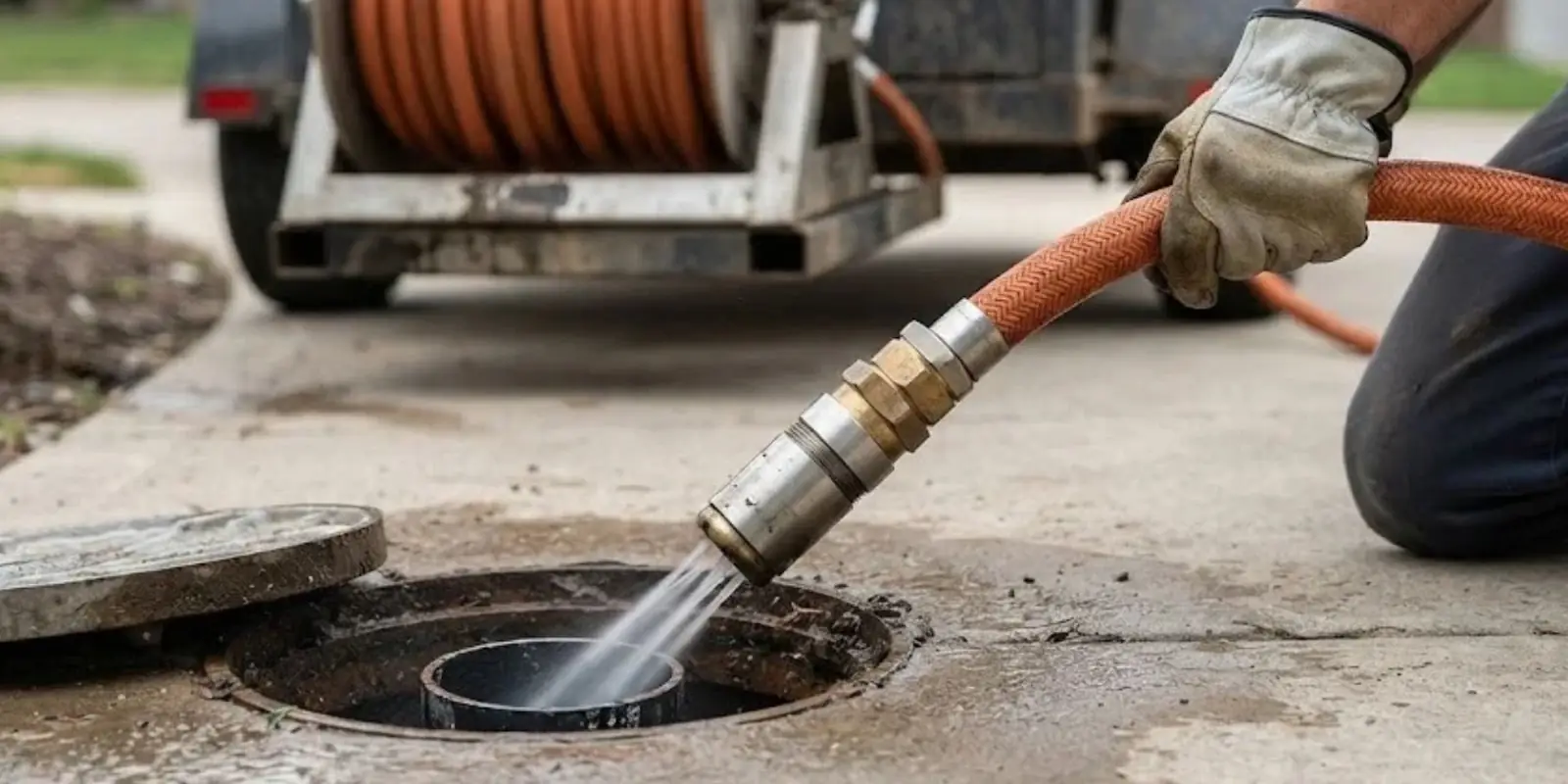
A jetter pump pushes water through a flexible hose at several thousand psi, far above household pressure of around 60 psi. The nozzle has small rear-facing jets that pull the hose forward and a few forward jets that break up the blockage. On the way out, we pull the hose back slowly so the spray rinses the pipe wall.
That scouring is the difference from a cable. A cable cuts a hole through the middle of a clog, and grease or scale stays on the walls. A jet takes the buildup off the pipe, which is why a jetted line often stays open much longer than a snaked one.
Hydro Jetting problem right now?
Call the 24/7 line. Tell us what you see, and we will tell you what to do first and what a visit involves.
Problems that point toward jetting
Jetting suits a handful of situations. If yours does not match one of these, a plain cable pass or a camera look may be the smarter first step.
Snaked, then clogged again
A cable clears a channel, but the grease or scale left on the wall catches new debris within weeks.
Grease buildup
Restaurants and busy kitchens send fat into the line. It cools and coats the pipe like candle wax.
Root intrusion
Fine roots enter through joints and grow into a mat. Jetting with a cutting nozzle clears them, though they regrow if the joint stays open.
Scale in cast iron
Older cast iron pipe develops rough, rusty scale that snags paper. A jet removes loose scale and smooths the flow.
A cable that stops far out
When a snake stops partway down a long line, the blockage may be dense and need the pressure of a jet.
Slow drains in many fixtures
Every fixture drains slowly, though none is fully blocked, which suggests a line coated along its length.
Grease, roots and scale, and why each behaves differently
Grease is the commonest cause in kitchen lines. It arrives hot and liquid, then cools and sticks. Hot water from the jet softens it, and the pressure strips it off the wall. If you want it to stay gone, keep fats out of the sink and wipe pans with a paper towel first.
Roots are different. They enter looking for moisture, and Indianapolis averages 43.63 inches of precipitation a year, so soil stays moist enough to draw them. Jetting cuts and flushes the roots we reach, but it cannot seal the joint they came through. If roots return, the camera shows where and we discuss sewer line repair.
Scale and mineral crust build on iron and old steel pipe as the pipe ages. Light scale comes off easily. Heavy scale can hide a thin wall, so we look with a camera before choosing nozzle and pressure.
Hydro jetting or snaking
Both are legitimate. The question is what is blocking the pipe and what you want the result to last.
Hydro jetting
- Scours the full pipe wall, not only the center
- Handles grease, scale and root mats
- Needs a sound pipe and a cleanout or open access
- Uses more water and more setup time
- Costs more than a short cable pass
Cable snaking
- Quick for a single soft clog
- Works through a trap, vent or small cleanout
- Leaves residue on the pipe wall
- May tear a flimsy pipe if forced
- Often enough for hair and paper
When hydro jetting is the wrong tool
A jet is powerful, and a weak pipe can fail under it. If the camera shows a cracked, offset or collapsed section, pressure can wash soil into the break or widen it. In that case jetting would make things worse, and we recommend sewer line repair first. We would rather tell you no than add to the damage.
Other limits are practical. A belly, where a section has sagged and holds standing water, will keep collecting waste whatever we flush. A line with no access point cannot be jetted until we create one. And a foul smell from a seldom-used floor drain is often a dry trap that needs water poured in, not a jet.
How we use the camera with the jetter
We run a camera first on lines that have clogged repeatedly. It shows the blockage, the pipe material, and whether the walls can take pressure. After the jet we run it again, so you see the cleaned pipe and any damage the debris was hiding.
A longer sewer camera inspection records the whole line from cleanout to street if the short run shows trouble. Indiana 811 rules matter only if repair means digging, and for that the notice must reach 811 at least two full working days before the dig.
Jetting in a Zionsville winter
NWS Indianapolis lists an average first freeze of October 26, and the all-time low there is -27 F. A jetter uses water, and hoses left outdoors can freeze. We work from an indoor cleanout when we can and drain the equipment afterward.
That matters because winter is when kitchen grease sets hardest in cold exterior walls. A scheduled jet in autumn clears a line before the cold weather and holiday cooking, and it costs less than a midnight backup in January.
What affects the price of hydro jetting
You will hear a price before the machine starts. These factors set it.
Length and diameter of the line
A 40 foot 2 inch kitchen branch is a shorter job than 90 feet of 4 inch main.
What is in the pipe
Grease and soft debris move quickly. Dense root mats and heavy scale take repeated passes.
Access
A good cleanout speeds the work. Without one we may need to pull a toilet or open a vent.
Camera before and after
Camera runs add time but confirm the result and show pipe condition.
Water and setup
Jetting needs steady water and a clear route for the hose, and a long run or a hard-to-reach spot adds time.
Insurers generally treat a sudden, accidental water event differently from maintenance. Cleaning a line that clogged over time is usually a maintenance cost. Some policies add sewer backup coverage, so check your policy and ask your agent.
Call, tell us what the line has done, and we will price the job for your pipe, not a guess.
Call (317) 740-1302What we will and will not do
Our team is licensed and insured, and you can confirm any plumber in the state's online license verification from the Indiana Professional Licensing Agency. We do not jet septic tanks or clear municipal mains. If neighbors are backing up too, call the Town's wastewater office, because the problem may sit in the town line.
For a routine household clog, drain cleaning is usually the first step. For a main line backing up into floor drains, see sewer line cleaning. Permits come into play only if a repair follows.
Frequently asked questions
Yes. The emergency line is open 24/7, and we book same-day appointments when available. If sewage is coming up, we start with a camera so we can tell whether a jet is safe for the pipe.
Stop water use in the house until we have looked at the line.
It depends on the blockage. A cable is quick for a single soft clog. A jet cleans the whole pipe wall, so it suits grease, scale and roots, and repeat clogs.
Our drain cleaning page covers cabling in detail.
On a sound pipe it does not. On a cracked, collapsed or badly corroded pipe, pressure can make the damage worse. That is why we look with a camera first and set the pressure to the pipe material.
Often yes, if the stop was a root mat or dense grease. If the cable met a collapsed section or a foreign object, a jet will not clear it, and a camera will show which.
Tell us how far the cable went. That distance helps us find the spot.
No. It clears the roots that are inside the pipe, but it cannot close the joint they entered through. How fast they return depends on the tree and the joint. A camera shows whether repair is the better fix.
Not always. A dry trap in a seldom-used floor drain or a sink often causes the smell, and pouring water into it can fix that. A smell with slow drains throughout the house is a better reason to book a camera look first.
Cleaning a line leaves the pipe as it is. If a repair follows, the Zionsville Planning & Building Department can say what permit applies.
Sources
Figures and guidelines on this page are taken from these public sources. Local rules and utility details can change, so check the source before you rely on a number.
- Indianapolis normals: annual precipitation 43.63 in, January normal low 20.9 F (Federal agency)
- Average first freeze October 26 (Federal agency)
- Two full working days notice before digging (Agency)
- License verification (State of Indiana)