
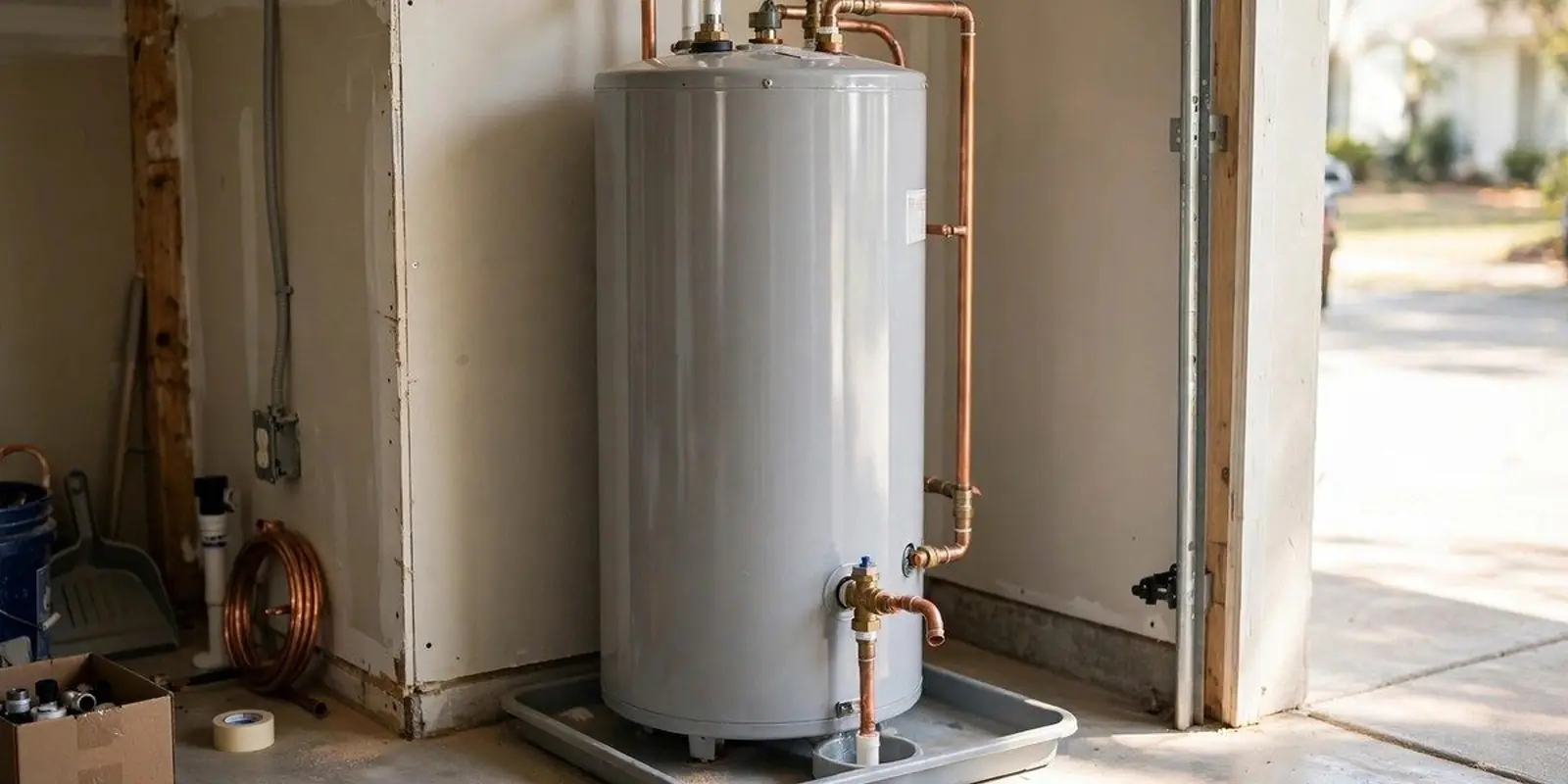
When a failed tank needs replacing right now
A tank that is bulging, leaking from its seam or running a steady stream from the bottom will not recover. A 40-gallon tank holds about 333 pounds of water, enough to ruin drywall and flooring fast. If the floor around it is wet and the tank is also hot, keep children and pets away. Scalding water and a slippery floor are a bad pairing.
Rust-colored hot water together with a leak means the lining has failed. Do not wait for a better time, because failed tanks tend to get worse overnight.
What to do while you wait for a replacement visit
The aim is a dry, safe space for the new unit and a clear record for your insurer.
Shut off fuel and power
Breaker off for electric, gas valve closed for gas. A gas smell at any point means leave the house and call the gas utility or 911 from outside.
Close the cold water valve
It sits on the cold pipe entering the top of the tank. A quarter-turn ball valve is parallel to the pipe when open and crosswise when closed.
Photograph the data label
The label lists capacity, fuel type and model number. That helps us arrive with a matching unit or a clear idea of what to substitute.
Clear a path
Remove stored items from the stairs, the hallway and the area around the heater. A 50-gallon tank weighs over 400 pounds when full, so the route matters.
Note what the old unit connects to
Look for a vent pipe, a gas line with a shutoff, a drain pipe from the relief valve and any pan beneath. Photos of each save time on site.
Age, symptom and the verdict
Where your unit sits in its expected life changes the answer. DOE lists storage tanks at 10 to 15 years, tankless at about 20, and heat pump models at 10 to 15.
| What you see | Age of the unit | Our usual advice |
|---|---|---|
| Water coming from the tank seam or bottom | Any age | Replace, since a rusted-through tank cannot be sealed |
| Leak at a fitting or relief valve | Under 10 years | Repair first, because the tank wall is dry |
| Second leak or failed part in a year | 10 years or more | Replace, before another part follows |
| Rust in hot water only | 10 years or more | Replace soon, since the lining is wearing out |
| No hot water, tank is dry | Under 8 years | Repair the element, thermostat or pilot |
| Old tank with a failed gas control valve | 12 years or more | Weigh the part against a new unit |
If your case sits on the repair side of this chart, our water heater repair page covers how we pin down the failed part.
Water Heater Replacement problem right now?
Call the 24/7 line. Tell us what you see, and we will tell you what to do first and what a visit involves.
Signs the tank is at the end of its life
One of these may be a repair. Two or three together usually mean replacement.
- Moisture beneath the jacket A damp insulation blanket or a rust trail down the side of the tank points at a failing wall.
- Rust flakes in the water Brown flakes at the tap or in the drain valve discharge mean the steel is corroding from within.
- A sacrificial anode already gone Once the rod is consumed, the tank starts to rust. A pulled rod that is a bare wire confirms it.
- Constant relief valve drips If the valve was replaced and it still drips, the cause is system pressure, and a failing tank is one possibility.
- Heavy sediment and noise Rumbling that returns after a flush means scale has hardened, and the burner or element is working through a crust.
Tank, tankless or heat pump
Replacing like for like is the simplest path, though not always the best one. Here is how the options differ.
Storage tank (gas or electric)
- Lowest upfront work, since it matches most existing connections
- Holds 40 to 50 gallons in most homes, with a standing heat loss
- DOE lists a 10 to 15 year service life
- Hot water runs out when the tank does, then recovers slowly
Tankless or heat pump
- Tankless heats on demand, lasts about 20 years per DOE, and needs the right gas line size and venting
- Heat pump models pull warmth from surrounding air and use less electricity, also 10 to 15 years per DOE
- A heat pump unit needs open air space and a condensate drain
- The federal 25C credit covered heat pump water heaters only through 2025, so do not count on it now
How much capacity your household needs
Capacity follows the number of people and how they use hot water at once. A tank sized for two people will run short for five, especially when a shower, a dishwasher and a laundry load overlap. Moving from 40 to 50 gallons helps a household of four, though the new tank must still fit the closet and the floor drain.
What a replacement visit involves
We confirm fuel, capacity and venting first. Then we shut off water and power or gas, and drain the old tank by hose to a floor drain or outside. The old unit comes off the supply lines, gas connection and vent, and goes out. We set the new tank on a pan or a level base, reconnect with new flex lines, and fit a new relief valve with a discharge pipe pointed down.
Gas connections get a soap-solution leak test, and the vent gets a draft check. The tank is filled with a hot tap open so air escapes, and only then is power or gas restored. Last, we show you the temperature dial and each shutoff valve.
When the new unit is not a like-for-like swap
A newer, bigger or different type of unit may need piping changes, a new vent, a closed-loop expansion tank or a larger gas line. Those add to the job, and we say so before work starts. If the swap is straightforward, it is done in a single visit. If the choice is tankless, our tankless water heater page lays out the trade-offs.
What affects the price of water heater replacement
The unit you pick and the work around it set the total, and a number quoted blind would be a guess.
Type and size of unit
A 50-gallon tank, a tankless unit and a heat pump model are different appliances with different installed costs.
Venting and fuel connections
A change from an atmospheric vent to a power vent or a larger gas line adds materials and labor.
Code updates
An expansion tank, a drain pan or a new relief valve discharge may be needed when the old setup is not current.
Access and haul-away
Stairs, tight closets and attic installs take more time, and the old tank has to leave the house.
Timing
Night, weekend and holiday visits may price differently from a scheduled day appointment, and we say so beforehand.
Insurers generally pay for sudden water damage from a burst tank, and not for a heater that simply wore out. Keep your photos and ask your agent how your policy treats a failed tank.
Tell us the unit's age and fuel type, and we will give you a clear price for your house before work starts.
Call (317) 740-1302Replacing a water heater in a Zionsville home
NWS Indianapolis lists the average first freeze on October 26 and the January average low at 20.9 F. A heater that dies in that stretch leaves a household without hot water in the coldest weeks. That is why a 24/7 line matters for tanks that fail at night or on a weekend.
Permit rules for a replacement vary, so ask the Zionsville Planning & Building Department, which reviews building permits for the Town. We also serve neighboring Whitestown and nearby towns. You can confirm any plumber's license through the state's online license verification, and we are licensed and insured. We do not promise a specific arrival time.
Frequently asked questions
Yes. The line is answered 24/7, with same-day appointments when available. Call with the model label and fuel type if you can read them, and we will tell you what to shut off while you wait. We do not promise an arrival time.
Leaks from the tank wall, rust in the hot water, and a unit past 12 years with a failed major part usually point to replacement. A tank under 8 years with a bad element or thermostat is a repair.
The US Department of Energy lists storage tank heaters at 10 to 15 years, tankless at about 20 years and heat pump models at 10 to 15 years. Hard water and skipped upkeep can shorten that.
Often yes, if there is a 240-volt circuit and open air space around the unit. Gas lines and flues have to be capped or removed properly, and the heater will cool a small room. The 25C federal credit ended after 2025.
Rules vary by project, so put the question to the Zionsville Planning & Building Department, the Town office that reviews permits. Ask whether a like-for-like swap is treated differently from a fuel change.
Usually the water damage from a sudden burst is covered, and the old heater is not. Policies differ, so photograph everything and ask your agent before cleanup.
Gas and venting mistakes are dangerous, and an electric swap involves 240-volt wiring. Indiana requires a license to work as a plumbing contractor or journeyman. A mistake with the relief valve or the vent can cause real harm.
Sources
Figures and guidelines on this page are taken from these public sources. Local rules and utility details can change, so check the source before you rely on a number.
- DOE lifespans: storage 10-15, tankless about 20, heat pump 10-15 (Federal agency)
- 25C credit ended after 2025 (Federal agency)
- Average first freeze October 26 (Indianapolis) (Federal agency)
- January average low 20.9 F (Federal agency)
- Planning & Building Department (Local government)
- License verification (State of Indiana)