
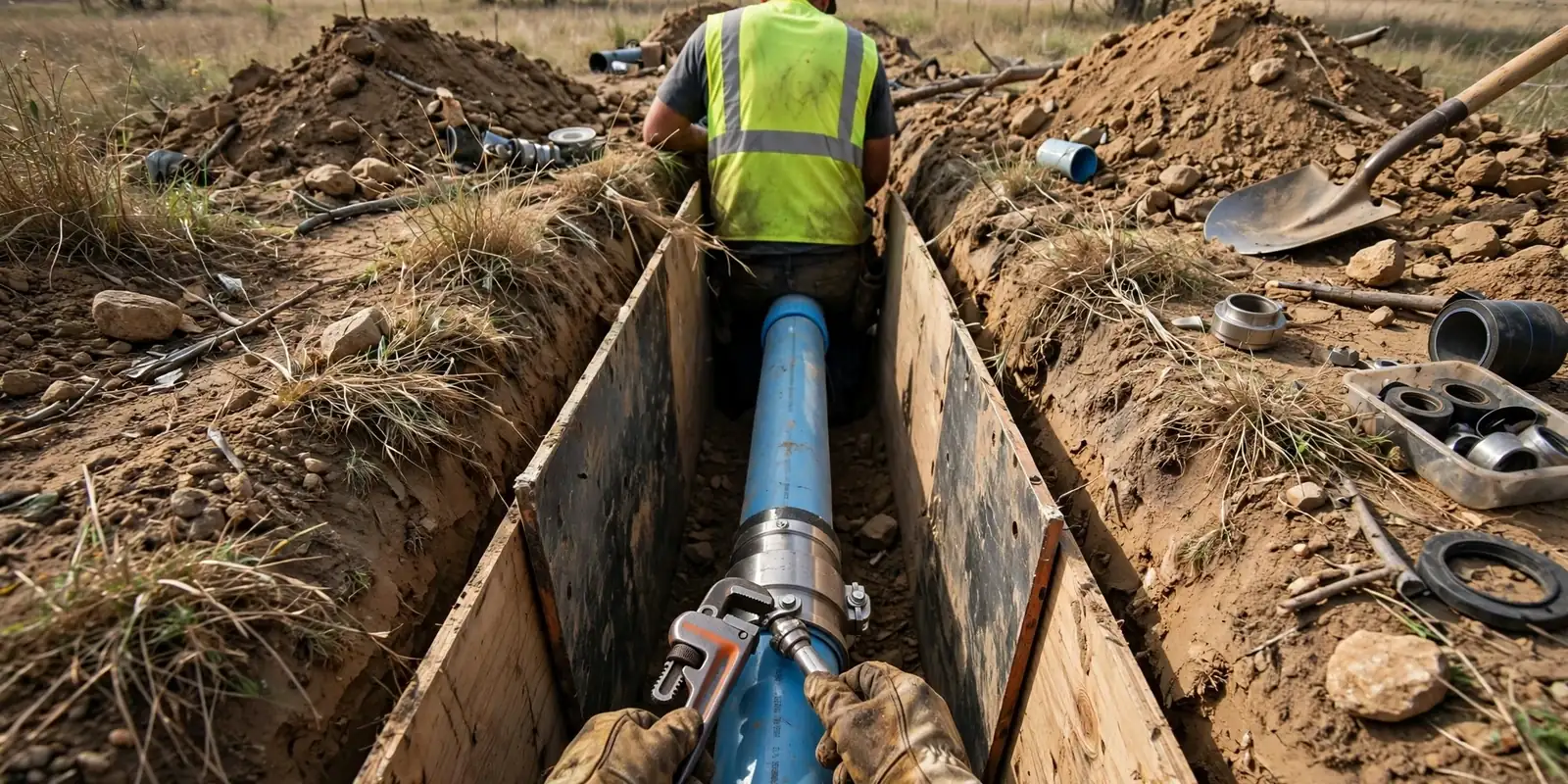
When a broken water line is an emergency
Call right away when water is bubbling up in the yard, a sinkhole or soft patch is opening near the line, or a basement is taking water where the pipe enters the foundation. A full break can move a lot of water in an hour, and it can wash soil out from under a driveway or slab.
A sudden loss of pressure at every tap, especially with a meter that is spinning, points the same way. The line is staffed after hours, on weekends and on holidays, and a plumber can talk you through the shutoff before anyone arrives.
What to do while you wait
These steps limit the damage and make the repair faster.
Close the main shutoff
Look where the pipe enters the foundation, commonly in a basement or crawl space. Turn the valve clockwise until it stops.
Check the meter
With every fixture off, a moving meter dial or a spinning flow indicator means water is still escaping on your side of the line.
Look for the curb stop or meter pit
A shutoff in the yard may belong to the utility. Do not force it, and call the water utility on your bill about anything on the meter side.
Keep people and vehicles off soft ground
A void under a driveway or lawn can give way. Mark the spot and stay clear.
Photograph the damage
Take pictures of standing water, the meter reading and any affected rooms before cleanup, for your insurer.
Why water service lines fail here
Indiana's Office of Utility Consumer Counselor says the buried supply pipe from the meter to the building typically falls to the customer. A leak on this stretch is yours to fix, and yours to pay for in water used. Before spending money, call the water utility on your bill to confirm where your side starts.
Winter does most of the damage in this region. Indianapolis averages a January low of 20.9 F, and the city recorded -27 F in January 1994. Repeated freezing and thawing moves the soil around a pipe, and old fittings, corroded steel and aged joints give out where that movement concentrates.
Water Line Repair problem right now?
Call the 24/7 line. Tell us what you see, and we will tell you what to do first and what a visit involves.
Signs the water service line is leaking
The line is out of sight, so the clues show up elsewhere.
The meter moves with everything off
Shut off every fixture and appliance. If the dial still turns, water is escaping somewhere past the meter.
An unexplained rise in the bill
A sustained jump in water use without a change in habits can point to a leak in the supply line.
A wet or soft spot in the yard
Grass that stays green and soggy in dry weather, or a muddy patch between the meter and house, marks a likely path.
Low pressure at every tap
When both hot and cold weaken together, the problem is upstream of the water heater.
Hissing near the entry point
A faint hiss near the wall where the pipe comes in suggests a leak under pressure close to the house.
Muddy or discolored water
A break can pull soil into the pipe, and corroded steel can shed rust.
How we find a buried line leak
We start with the meter. We shut off the house, read the dial, and wait. Then we put a pressure gauge on an outdoor hose bib to see whether the line holds pressure when the valve is closed.
If the line is leaking, acoustic listening gear on the pipe, valve and meter tells us roughly where the sound is loudest. A pipe locator traces the route, so we dig in one place, not four. Our page on leak detection covers the same tools for leaks inside walls and slabs.
Service line leaks and buried pipe
A buried leak does not always surface. Water can travel along the pipe trench or drain away into gravel, so a dry yard does not mean a dry line. A leak the size of a pencil lead still adds up, since the EPA reports that the average household leaks waste more than 9,300 gallons a year across all fixtures.
Materials matter too. Copper, galvanized steel, polyethylene and older lead lines all behave differently. Steel rusts shut from the inside, copper pits or splits, and plastic can crack where it was bent. We identify the pipe at the entry point, then plan the repair around what is really down there. If you suspect lead, ask your water utility about its records and testing.
Repair or replace the water line
A single leak and a pipe that is failing along its length call for different answers.
| Option | Best when | Trade-off |
|---|---|---|
| Spot repair | One clear leak on an otherwise sound pipe | Other weak spots remain in the line |
| Trenchless replacement | A long run under a driveway, patio or mature landscaping | Needs entry pits at both ends and a straight enough path |
| Open trench replacement | Short runs, or where the old route cannot be reused | Most yard disturbance and restoration |
| New line on a new route | The old path is blocked or under a structure | Longer job and more planning with the utility |
We will tell you why one option fits your line better, and if a spot repair is enough, we say so.
Low water pressure from the service line
Low pressure has several causes, and the supply line is only one. A pinched or corroded service pipe restricts flow at every tap. A partly closed main valve, a failing pressure regulator or a clogged aerator can do the same on a smaller scale.
We check static pressure at the hose bib, then pressure with a tap running, because a big drop when water flows suggests a restriction. If only one fixture is weak, the problem is local to that fixture, which our faucet repair work covers. If the utility's side is weak, we tell you to call them and explain what you saw.
The meter, the main and who to call
The meter belongs to the water utility. For anything about the meter, the meter pit or the main in the street, call the water utility named on your bill. We repair the line from the meter side into your house, not the utility's equipment.
If you have a private well, there is no utility meter. Boone County Health Department requires a permit to drill or repair a private well and registered well drillers, so contact them first. For a municipal connection, a large water main replacement is a utility project and not something we do on a home service call.
Digging rules and permits
Indiana 811 receives your notice and passes it on to utility operators. The notice must arrive at least two full working days before digging begins and no more than ten calendar days before. A working day runs 7 a.m. to 6 p.m. Indianapolis time, excluding weekends and legal holidays.
A ticket expires 20 days after it is submitted, so an old ticket may need renewing. Because a leak repair is often urgent, the work is planned around these timing rules. Permit needs depend on the job, so ask the Zionsville Planning & Building Department.
What affects the price of water line repair
Costs vary with the line, the ground and the method. These are the main drivers.
Length of line
The distance from meter to house sets how much pipe and digging a replacement needs.
Depth and ground
Deeper lines and rocky or wet soil take longer to expose.
Surface above the pipe
Lawn is the simplest. A driveway, sidewalk or patio adds cutting and restoration.
Pipe material
Copper and polyethylene differ in material cost, fittings and how well they suit trenchless methods.
Emergency timing
Night and weekend calls involve different staffing than a scheduled daytime visit.
Sudden damage, such as a break that floods a room, may be covered. Seepage over months, or the pipe itself, generally is not. Some insurers sell a service line endorsement, so ask your agent what yours includes and read the policy.
Call and we will give you a clear price for your line before any digging begins.
Call (317) 740-1302Licensed plumbers and honest limits
We are licensed and insured, and any Indiana plumber can be looked up through the Professional Licensing Agency's license verification before you hire. The state treats unlicensed contracting or journeyman work as unlawful.
We serve Zionsville and nearby towns, and that includes the Whitestown area. If the leak is inside the house, burst pipe repair covers that situation. A line that is corroded end to end may lead to a talk about whole-house repiping. Ask about a same-day appointment when you call.
Frequently asked questions
Yes. The emergency line runs 24/7. A service line that breaks late on a Sunday is as urgent as one that breaks on a weekday morning.
We do not state an arrival time by phone. We do walk you through closing the main and checking the meter.
Indiana's consumer counselor says the buried supply pipe between the meter and the building is typically the customer's responsibility. The meter and main belong to the utility.
Call the water utility on your bill to confirm where its ownership ends at your address.
Turn off every fixture, then read the meter, wait two hours and read it again. The EPA says that if the meter changes with no water in use, you probably have a leak.
If the toilets, faucets and appliances check out, the supply line is the next suspect.
Causes include a leaking or restricted service line, a partly closed main valve, a failing pressure regulator or a problem on the utility side. A pressure gauge reading at the hose bib helps separate them.
Low pressure with a spinning meter and nothing running points to a leak.
For most digging, yes. Indiana 811 must receive your notice at least two full working days before you dig, and no more than ten calendar days before. Ask whoever digs, including us, who files the notice before the shovel moves.
Often, yes. Trenchless methods pull or burst a new pipe through the old path from entry pits at each end. They need a line that is reasonably straight and accessible.
A short repair under open lawn may be simpler with a trench. We explain which fits.
No. The main and the meter belong to the water utility, so call the number on your water bill. We work on the line from the meter to your house and inside your property.
Requirements turn on the job, so call the Town's Planning & Building office on W Oak Street before starting. Tell them the line length and whether it crosses a street or easement.
Sources
Figures and guidelines on this page are taken from these public sources. Local rules and utility details can change, so check the source before you rely on a number.
- Indiana 811 notice rules before digging (Agency)
- EPA WaterSense, check your water meter for leaks (Federal agency)
- Town of Zionsville Planning & Building Department, permit review (Local government)
- State of Indiana license verification (State of Indiana)