
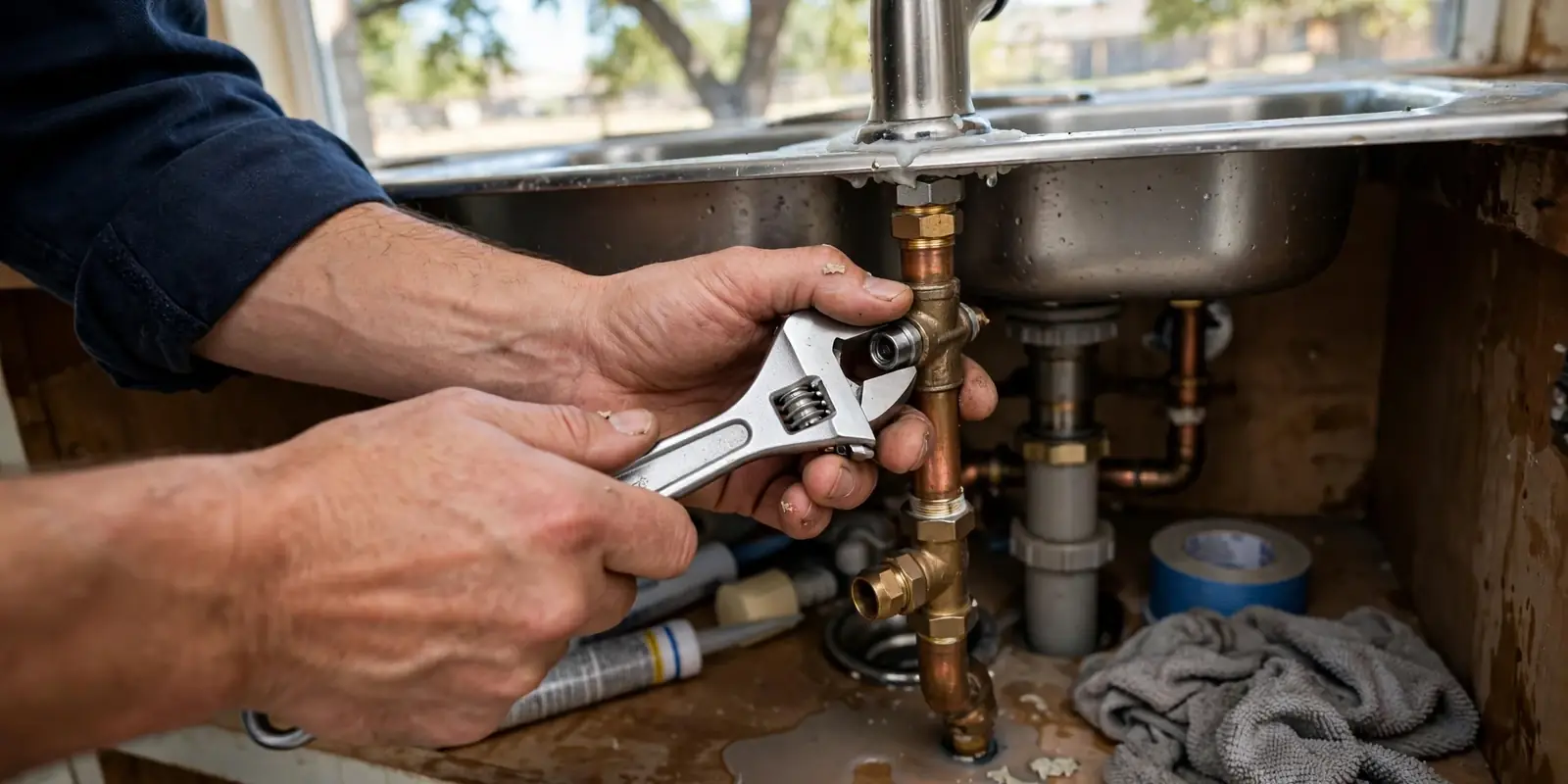
When a faucet or valve failure is an emergency
A supply line that has split, a shut-off valve spraying from its stem, or a sink that is dropping water into the cabinet and floor cannot wait. Unlike a drip, these keep running, and a night or weekend leak soaks the cabinet base, the floor and sometimes the room below.
The tricky case is a fixture whose own shut-off valve will not close. That leaves the main water shutoff as the only way to stop the water, and the main may also be stiff if it has not been turned in years.
What to do while you wait
Water damage grows by the minute, so work through these in order.
Try the fixture shut-off
Turn the small oval handle under the sink clockwise. Stop if it spins freely or leaks more, and do not use pliers on a corroded valve.
Close the main water valve
It is usually where the line enters the house, often in a basement or crawl space. Turn it fully clockwise, then open the faucet to drain pressure.
Empty the cabinet
Pull out cleaners and stored items, put a bucket under the leak and soak up standing water with towels.
Mind the electricity
If water has reached outlets or a garbage disposal plug under the sink, leave the area dry and call us.
Document it
Photograph the leak, the valve and any damaged cabinet or flooring before you clean up, for your insurance agent.
Why faucets fail in Zionsville homes, and what winter adds
Faucets wear from use and from minerals in the water. Indiana's Office of Utility Consumer Counselor says one drip a second wastes roughly 260 gallons a month. EPA WaterSense lists dripping faucets and leaking valves among the common culprits behind a high bill. A repair is cheap next to months of that.
Cold snaps matter too. Indianapolis normals put the January average low near 21 F, and the state's consumer counselor suggests opening cabinet doors under sinks on exterior walls when temperatures hit zero. A sink supply line against an outside wall is the first one to freeze, so a slow drip after a cold night is worth checking.
Faucet & Sink Repair problem right now?
Call the 24/7 line. Tell us what you see, and we will tell you what to do first and what a visit involves.
Signs a faucet, valve or drain needs work
What you see at the fixture usually points to the part that failed.
Drips from the spout
A worn cartridge, washer or seat is letting water past. A drip at the spout is the most common faucet repair.
Leaks at the handle or base
Water around the handle or the base of a kitchen faucet points to worn O-rings or a loose mounting.
Low or uneven flow
A clogged aerator, debris in the cartridge or a partly closed shut-off valve can cut the stream.
Handle is stiff or loose
Mineral buildup or a worn cartridge makes the handle hard to turn, or lets it spin without control.
Wet cabinet under the sink
Feel the supply lines, the shut-off valves and the drain connections. The wettest joint is usually the culprit.
Shower drips after shutoff
A worn shower cartridge or valve body sends water to the head when the handle is off.
Tub or shower drains slowly
Hair and soap collect in the strainer and the drain tee, and water backs up around your ankles.
How we find the cause
We dry the cabinet, then run the fixture while we watch each joint with a light and a paper towel. Water that appears only with the handle on comes from the faucet or supply. Water that appears only when the drain runs comes from the trap or drain connections.
For a dripping faucet we shut the supply, take the faucet apart and look at the cartridge, seats and O-rings. For a shower we pull the trim, identify the valve brand and test the cartridge. We tell you what failed and whether the part or the whole fixture makes more sense.
Faucet, valve and fixture repair
Faucets use four main designs, compression washers, ball, cartridge and ceramic disc, and each wears out differently. A compression faucet drips when the rubber washer hardens. A cartridge or ceramic disc faucet drips when the seals or the disc face wear, and the fix is usually a new cartridge.
Repair is the right answer when the faucet body is sound and a new part is on the shelf. Replacing the faucet makes sense when the finish is flaking, the body is corroded, or the maker no longer sells the parts. When a replacement is warranted, we install the new faucet, new supply lines and a fresh seal.
We do not repair what we cannot source. If a discontinued faucet needs a part nobody sells, we will say so and show you the options.
Repair the faucet or replace it
Both choices are reasonable. The lists below show what usually tips the decision.
Repair when
- The faucet body and finish are in good shape
- A cartridge, washer or O-ring is the only failed part
- The brand still sells the part
- You like the faucet and want to keep it
Replace when
- The body is corroded or the finish is peeling
- The faucet has been repaired more than once
- Parts are discontinued or hard to find
- You want a different style or a pull-down spray
Shut-off and supply valves that will not close
The small valve under a sink or behind a toilet should stop the water to that fixture. Many are old multi-turn valves that corrode shut or leak at the stem when turned. Forcing one is how a slow weep becomes a spray.
We replace a bad fixture valve with a quarter-turn ball valve, usually when the main water is off for a few minutes. If the valve is on a copper line, we cut it out and solder or use a push fitting. If the main shutoff also will not close, we replace that, since a main that does not close is a risk in a real emergency.
Shower valves and showerheads
A leaking showerhead is often a worn washer or loose threads, and a new head with fresh tape fixes it. A shower that drips after the handle is off, or runs hot and cold unevenly, usually has a worn cartridge in the valve behind the wall. Replacing it needs the right cartridge for the brand and sometimes a stuck trim ring to be released.
Tub, shower and sink drains
Slow tub and shower drains are usually hair and soap at the strainer or in the tee below. We clean them by hand, with a small cable, or by removing the stopper assembly. If every drain in the bathroom runs slow, the clog is farther down and our drain cleaning service reaches it. A bathroom sink that gurgles may also have a venting problem.
What affects the price of faucet and sink repair
Fixture work ranges from a small seal to a new faucet with new valves, so we price after seeing it.
Repair or replacement
A cartridge or O-ring is a smaller job than a new faucet with new supply lines.
Faucet brand and model
Parts for common brands are easy to get. Specialty finishes and older models take longer to source.
Valve condition
If the shut-off valves are corroded, replacing them adds work but prevents a repeat failure.
Access
A kitchen faucet with a crowded cabinet or a shower valve behind a tile wall takes more time.
Time of the call
Night and weekend leaks go through the 24/7 line, and you hear the price before we begin.
Standard homeowner policies usually cover sudden and accidental water damage, such as a burst pipe, and usually do not cover gradual leaks, wear or the failed part itself. Check your policy and ask your agent.
Call us and we will give you a clear price for your fixture before work starts.
Call (317) 740-1302Our approach in Zionsville
Before anyone opens a wall or cuts a supply line, look up their license on the state's online license verification, which draws on Indiana Professional Licensing Agency records. We are licensed and insured. Whether your fixture project needs a permit varies, so ask the Zionsville Planning & Building Department.
A fixture leak is sometimes a symptom of a bigger problem, such as old supply lines or a hidden pipe leak. If so, we point you to leak detection or repiping the house. We serve Zionsville and nearby towns, and neighboring Whitestown.
Frequently asked questions
Yes, a split supply line at 2 a.m. or a spraying valve on Sunday is what the 24/7 line is for. Same-day appointments are available when the schedule allows. We give no arrival promise, but we talk you through closing the main and clearing the cabinet.
A drip at the spout means the cartridge, washer or seat no longer seals. Indiana's consumer counselor says a faucet dripping about once a second wastes roughly 260 gallons a month. Replacing the part usually fixes it.
Do not force it with pliers. Close the main water valve to stop the flow, then call us. We can replace the old valve with a quarter-turn valve so it works next time.
A showerhead washer is an easy fix. A valve behind the wall is harder, because you need the brand, the right cartridge and a way to shut off water to that valve. If the valve will not shut off, call a licensed plumber.
Remove the stopper or strainer and clear hair by hand. If water still backs up, the clog is deeper. Avoid chemical drain cleaners, since they can damage old pipes and are hard on anyone who works on the line next.
Yes. We replace cartridges in kitchen, bathroom and tub faucets, and we repair utility sink faucets and drains. For jetted tubs, we work on the supply and drain plumbing, though the motor and jets are usually the tub maker's service.
Permit rules vary, so ask the Zionsville Planning & Building Department before you move supply lines or add fixtures. A straight swap in the same spot is a different question from a remodel.