Do you actually need a softener
How hard your water is depends on where it comes from, and we will not guess at your number. Test your tap with a strip kit or a lab test, and ask your water utility for its annual water quality report, which lists hardness.
Your water bill names your utility. If you are on a private well, hardness and other minerals vary by well, and the Boone County Health Department requires registered drillers and bacteria testing for new wells. Buy a softener because of a test result and visible scale, not because of a sales call.
Signs of hard water in the house
These are the common clues, and none proves hardness on its own.
White crust on faucets and shower heads
Calcium carbonate deposits left behind as water evaporates.
Spots on glasses after the dishwasher
Minerals dry on the glass and leave a film or spots.
Soap that will not lather
Hard water ties up soap, so you use more and still feel a film.
Weak flow from shower heads
Scale can narrow the small holes over time.
Water heater noise
Rumbling or popping from a tank can mean sediment and scale on the bottom.
Stiff laundry
Minerals can hold onto fabric fibers.
Softener, filter or reverse osmosis
These are three different tools for three different problems.
| System | What it does | What it does not do |
|---|---|---|
| Salt-based softener | Removes hardness minerals from all the water in the house | Does not remove chlorine taste, lead or most contaminants |
| Carbon or sediment filter | Reduces chlorine taste, odor and particles | Does not soften water or stop scale |
| Reverse osmosis (under sink) | Strips most dissolved solids from drinking water at one tap | Slow, wastes some water, and does not treat the whole house |
| Softener plus filter | Whole-house softening with a filter for taste or sediment | Costs more and needs two systems maintained |
| Salt-free conditioner | Changes how scale forms | Does not remove hardness, so results vary |
If your complaint is taste, a softener will not fix it. If your complaint is scale, a carbon filter will not fix it.
Planning water softener & filtration work?
Call for a clear price before work starts, and ask about same-day appointments when available.
What a softener installation involves
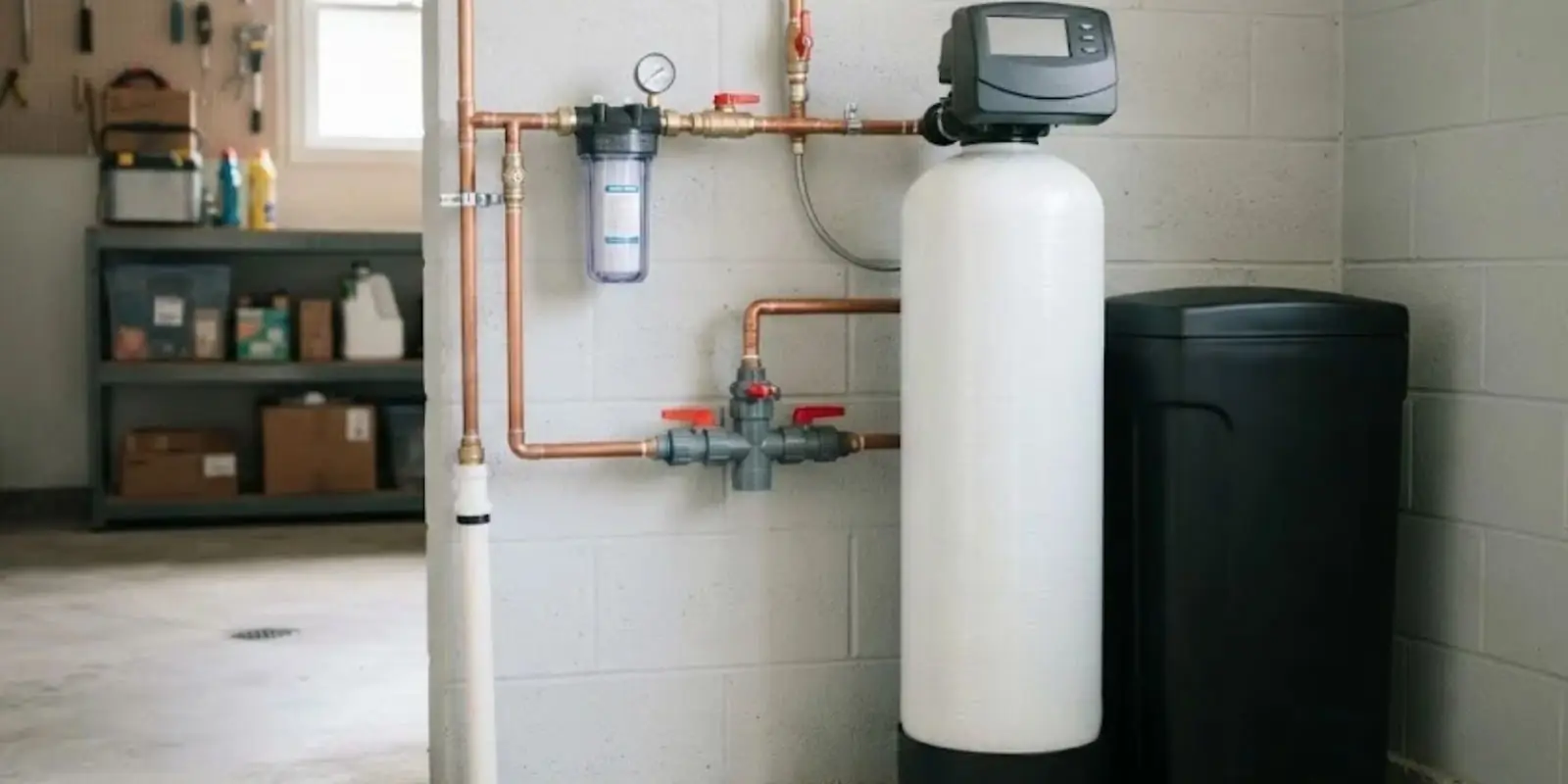
A softener needs a spot near the main water line, a nearby drain for the regeneration discharge, and a 120-volt outlet. We install a bypass valve so the system can be isolated for service, and we set up the drain line with an air gap so wastewater cannot siphon back.
Most households put the softener before the water heater so the tank sees soft water. Outdoor spigots are usually left on hard water, since there is no reason to soften water for a hose. Larger installs may call for new piping, which our plumbing installation page describes.
Salt versus potassium and what to know about sodium
The resin tank uses one or the other to recharge.
Sodium chloride (salt)
- Widely sold and usually the cheaper option
- Adds a small amount of sodium to the water
- Talk to your doctor if you are on a sodium-restricted diet
- Brine is discharged to the drain during regeneration
Potassium chloride
- Works the same way but costs more per bag
- Avoids the added sodium
- Often chosen for a low-sodium diet
- Brine is still discharged during regeneration
Softener repair and conditioner problems
Most service calls on softeners come from the same few things. A salt bridge forms and the brine tank stops making brine, a control head fails to cycle, the resin wears out, or the drain line clogs and leaks. Check the brine tank for a hard crust under the salt, and make sure the unit is plugged in and the bypass is open.
We repair the plumbing side of these systems, including drain lines, bypass valves, and leaks at the connections. We do not claim to service every brand, and electronic control heads from some makers need a factory part. We will tell you before booking.
How scale affects your water heater
A tank water heater collects sediment on the bottom, and the U.S. Department of Energy lists storage tank heaters as lasting 10 to 15 years. Hard water adds scale on top of that. Flushing the tank once a year is cheap care, and a softener upstream slows the buildup.
If the heater is already noisy or slow to heat, have it checked on a water heater repair call before assuming it needs replacing. A tankless unit can scale up inside its heat exchanger too, so ask about descaling if you have one.
What affects the price of a softener or filter
The system type and the installation work drive most of it.
System size
Capacity is matched to household size and water use, not just house size.
Distance to a drain
A long run to a floor drain or standpipe means more pipe.
Existing plumbing
Old or mismatched piping near the main may need to be changed first.
Added filtration
A pre-filter or an RO tap adds equipment and labor.
Salt and maintenance
Running costs continue after the install, so ask what to expect.
Water treatment equipment is usually treated as a home improvement and not as covered damage. A leak from a softener may be covered if sudden and accidental, but check your policy and ask your agent.
Call and we will go through your water and plumbing, then give you a clear price before work starts.
Call (317) 740-1302Next steps for Zionsville and nearby homes
Test the water first. If you are in Zionsville or a nearby town such as Whitestown, we can talk through the results on the phone. Our Whitestown service area page lists how we cover that side of Boone County.
Before you hire anyone, look them up on the state's online license verification from the Indiana PLA. Permits for new treatment equipment vary, so ask the Zionsville Planning & Building Department.
Frequently asked questions
Only a test can tell you. Test your tap, and ask your water utility for its annual water quality report, which lists hardness. If scale and spotting are real problems, a softener helps.
A softener removes hardness minerals so scale stops forming. A filter removes particles, chlorine taste and odor. They solve different problems, and some homes use both.
Neither wins across the board. Reverse osmosis cleans drinking water at one tap, while a softener treats the whole house against scale. RO is also slower and wastes some water.
We repair leaks, drain lines, bypass valves and plumbing connections on many systems. We do not service every brand, and some control heads need a factory part.
Not usually. A properly set softener adds only a small amount of sodium. If you are on a sodium-restricted diet, ask your doctor, and consider potassium.
The regeneration water goes to a drain through an air gap. It should not go into a sump pit that discharges to the yard. Ask us where yours should drain.
Permit rules vary, so ask the Zionsville Planning & Building Department.
Sources
Figures and guidelines on this page are taken from these public sources. Local rules and utility details can change, so check the source before you rely on a number.
- private well rules (county)
- DOE storage tank lifespan 10 to 15 years (Federal agency)