
What a basic swap includes
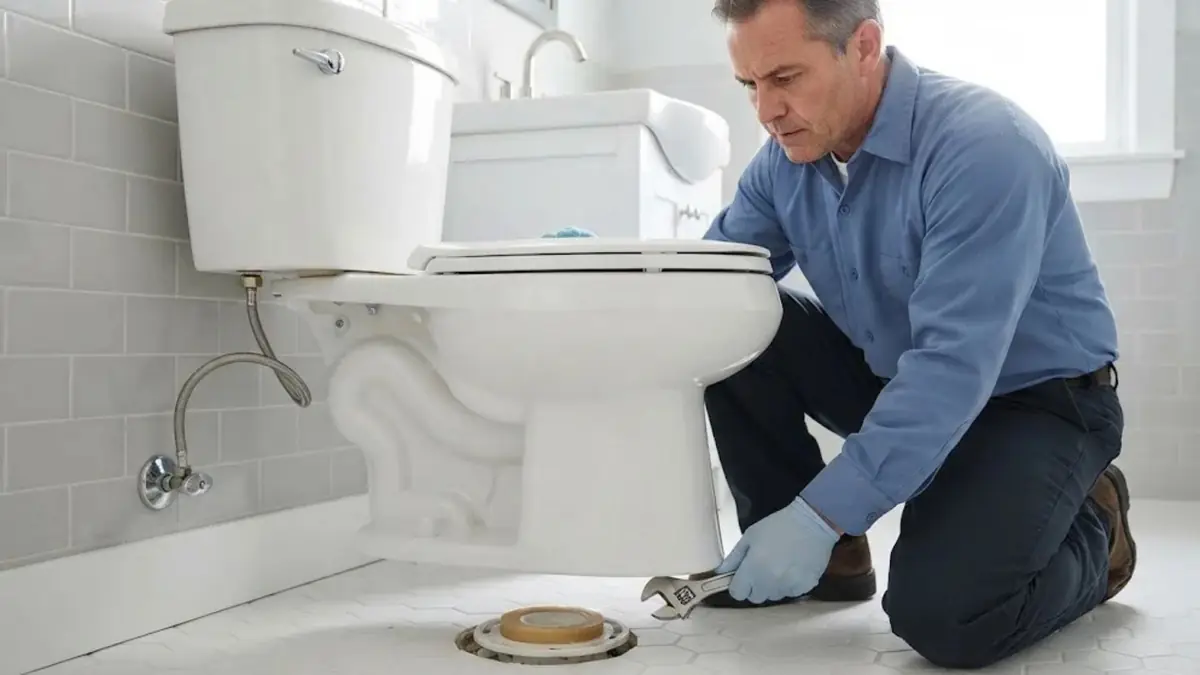
A straight swap means the old toilet comes off, the flange gets checked, a new wax or wax-free seal goes in, and the new toilet is set, bolted, connected and tested. The supply line and the shutoff valve are checked at the same time.
The toilet is bolted to a closet flange, which is the ring on the floor that connects the toilet to the drain. The seal between the two keeps sewage and sewer gas out of the room. If the flange is level with the finished floor and sound, the job is short.
What drives toilet installation cost
These are the items that change a quote more than the brand on the toilet.
- The toilet you pick One-piece, two-piece, comfort-height, elongated bowl and skirted designs all differ in price and in weight, and a heavy one-piece unit often needs two people to set.
- Flange and floor condition A cracked or corroded flange, or a floor that has softened from a slow leak, adds repair work before the toilet can sit solid.
- Shutoff valve and supply line An old valve that will not close fully, or a brittle supply line, is best replaced during the install.
- Haul-away of the old toilet A porcelain toilet is heavy. Ask whether removal and disposal are included.
- Access and layout A tight bathroom, a second-floor install or a wall-hung toilet with an in-wall tank takes much more time than a floor-mounted unit.
Simple swap or bigger job
Use this table to see where your job sits before you compare quotes.
| Job type | What it involves | Why the quote moves |
|---|---|---|
| Same-spot swap | Remove, new seal, set new toilet, test | Mostly labor and the toilet |
| New flange or repair | Replace a damaged flange, secure to subfloor | Extra parts and time |
| Subfloor repair | Cut out and replace soft or rotted boards | Carpentry added to plumbing |
| Moving the toilet | New drain and vent path | Piping, permits and finish work |
| Wall-hung toilet | In-wall carrier, wall opening, finish | Specialized parts and wall repair |
A quote that treats all five as the same job is not describing your house. Ask the plumber to say which row you fall in and why.
Want a licensed plumber to look at it?
Call the 24/7 line and describe what you are seeing.
How to read a toilet install quote
A good quote names the toilet model, says whether a new seal, bolts, supply line and shutoff valve are included, and says what happens to the old toilet. It also says what happens if the flange or floor turns out to be damaged.
That last point is worth asking about in advance. A plumber cannot see a soft subfloor until the toilet is up, so a fair quote explains how any added work will be priced and gets your approval before it starts. We give a clear price before work starts and talk through changes with you first.
If you buy the toilet yourself, ask whether the plumber installs customer-supplied fixtures and how the labor warranty works in that case. Some will, and some will not.
What the EPA says about water savings
Per EPA WaterSense, nearly 30 percent of the water used indoors goes down the toilet. A very old one can draw 6 gallons every flush. A WaterSense labeled model needs 1.28 or less, which beats the 1.6 gallon federal standard by 20 percent.
The agency says a swap can trim toilet water use by 20 to 60 percent, close to 13,000 gallons a year for an average family. EPA estimates that is more than $170 a year in water costs. Your own savings turn on the age of your toilet and your utility's rates.
Replace the toilet or repair it
A running or leaking toilet is not always a reason to buy a new one.
Repair makes sense when
- The bowl and tank are not cracked
- The problem is a flapper, fill valve or wax seal
- The toilet is a modern low-flow model
- The fix is a cheap part
Replace makes sense when
- The porcelain is cracked or the tank leaks
- The toilet clogs often and flushes weakly
- It is an older model using several gallons a flush
- You are remodeling the bathroom
When to call a plumber and when to try it yourself
Water on the floor around the base, a rocking toilet, or a sewage smell in the bathroom means stop and check. Close the shutoff valve behind the toilet, which is usually a quarter turn or a few turns clockwise, and mop up the water. Do not keep flushing if the bowl is rising.
A handy homeowner can replace a flapper or fill valve, and our toilet repair page explains when that is enough. Setting a new toilet is doable but unforgiving. A bad seal leaks under the floor where you cannot see it. Call us if the flange looks damaged or the floor feels soft. For a toilet that keeps clogging after a swap, a drain cleaning visit may find the real cause further down the line.
What this means in Zionsville
Zionsville's own sewer system is billed by the Town at one flat monthly rate for each residence, according to the Town. So a lower-flush toilet will not change that sewer charge. The savings EPA describes show up on the water side of your bills, so look at your water bill to see how your own utility charges.
The Census Bureau lists the median owner-occupied home value in Zionsville at $587,800 for 2020 to 2024, and 84.2 percent of homes are owner-occupied. For a home that you plan to keep, a toilet swap is a small project next to what a bathroom is worth. Buy a toilet that fits the room and flushes well, then have it set correctly once.
If a quote adds anything beyond a simple swap, such as moving the toilet or opening a wall, ask the Zionsville Planning & Building Department whether a permit applies. Rules depend on the work, so let them answer for your address.
Nearby towns
We also serve nearby Whitestown and other places on our service area page, so a neighbor outside Zionsville can ask for the same written price.
Frequently asked questions
A same-spot swap on a sound flange is usually a short visit. Damage found under the old toilet, such as a cracked flange or soft subfloor, makes it longer.
Either can work. Buying it yourself lets you pick the model, but ask whether the plumber installs customer-supplied fixtures and who covers a defective unit. If we supply it, the model, parts and labor are all on one written price.
The Town charges one flat monthly sewer rate per residence, so that line does not move with how much you flush. Savings show up on the water side, where EPA estimates more than $170 a year for an average family.
Labeled models are capped at 1.28 gallons a flush. The federal standard is 1.6, and a very old toilet can use 6.
A same-spot swap often does not raise the question, but moving a toilet or changing drain piping can. Phone the Town's building office, and we will describe the planned work so they can answer.
It is usually an uneven floor, a flange set too low or a bad seal. Do not keep using a rocking toilet, because the seal fails over time and water seeps under the floor.
Sources
Figures and guidelines on this page are taken from these public sources. Local rules and utility details can change, so check the source before you rely on a number.
- Toilets near 30 percent of indoor water use, up to 6 gpf old, 1.28 gpf WaterSense, 20 to 60 percent savings, EPA estimate over $170 a year (Federal agency)
- Town provides sewer service and bills a flat monthly rate per residence (Local government)
- Median owner-occupied home value $587,800 and 84.2 percent owner-occupied, 2020-2024 (Local government)
- Zionsville Planning & Building reviews building permits (Local government)