
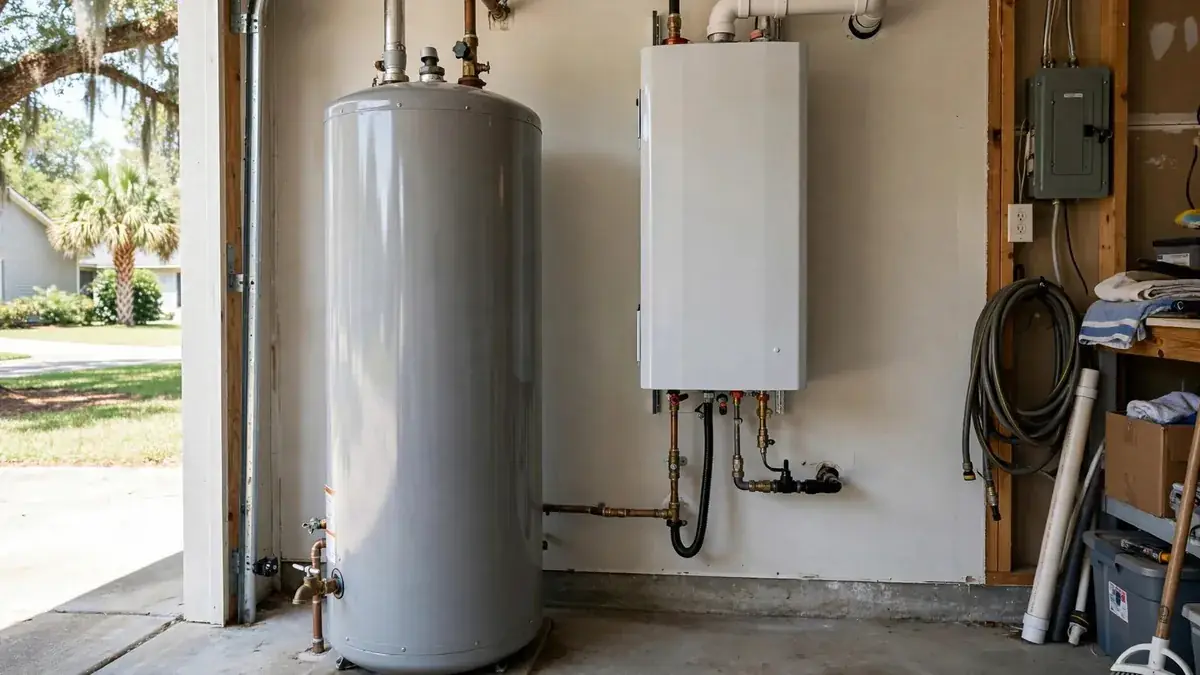
Keep a tank or convert? A side-by-side look
Neither choice is right for every house. This table lays out the trade-offs that matter in practice.
| Question | Stay with a tank | Convert to tankless |
|---|---|---|
| How long does it last? | DOE lists storage tanks at 10 to 15 years | DOE lists tankless at about 20 years |
| Where does hot water come from? | A stored supply, say 40 or 50 gallons, that can run out | Heated on demand, so it does not run out, but flow is limited |
| What changes in the house? | Usually the same hookups as the old tank | Gas line size, vent type, power and drain often change |
| Where does it sit? | On the floor, needs a pan or drain nearby | Wall mounted, frees floor space |
| What does maintenance look like? | Anode rod check, flushing sediment | Periodic descaling flush of the heat exchanger |
| What fails the plan? | Hot water runs out when many people shower | Too many fixtures running at once for the unit's flow |
Why lifespan matters more than the sticker
A tankless unit costs more up front and needs more installation work. What it can give back is time. DOE lists tankless water heaters at about 20 years and storage tanks at 10 to 15, so over two decades you might buy one tankless or buy a tank twice.
That math only works if you stay put and the unit stays healthy. Heat pump water heaters sit at 10 to 15 years in the same DOE list, so the longest life belongs to tankless.
Upgrades a tank-to-tankless conversion can require
Ask your plumber to walk through each of these before you accept a quote. Any one of them can change the scope of the job.
A bigger gas line
A tankless burner draws far more gas at once than a tank burner. The existing line may be too small and need to be upsized from the meter.
New venting
Many tankless units are sealed combustion and vent through stainless steel or plastic pipe to an outside wall or roof. The old tank flue is often not usable.
Power
A gas tankless still needs an electrical outlet for its fan and controls. If none is nearby, one has to be added.
Condensate drain
A condensing model makes acidic water that must drain to a floor drain or a neutralizer.
Valves and relief
Isolation valves with service ports let you descale the unit, and the relief valve still needs a safe discharge pipe.
Old tank removal
The tank, the old flue and its gas connection are taken out, and the wall or floor is patched.
Want a licensed plumber to look at it?
Call the 24/7 line and describe what you are seeing.
Who converts happily and who should skip it
A house with a few people and spread-out showers can feel different from one with heavy hot water use at the same time.
Tankless tends to fit when
- You plan to stay in the home for many years
- The gas meter and line can handle the load
- Hot water runs one or two fixtures at a time
- You want floor space back in a closet or basement
A tank may be the better call when
- You may sell within a few years
- Gas line and vent would need major rebuilding
- Several showers and the dishwasher often overlap
- Water is very hard and you will not maintain the unit
What tankless does not fix
Tankless does not make hot water arrive sooner at a far bathroom. The pipe between the heater and the faucet still holds cold water that must run out first. A recirculation loop or a point-of-use heater helps with that, not the main unit alone.
It also needs a minimum flow to fire. A trickle from a half-open tap may leave you with lukewarm water. And when two showers and a washing machine call at once, the unit may split the heat thin.
Gas safety during a conversion
Never cut or cap a gas line yourself. A gas smell at any point means getting out first, then calling the gas utility or 911 from outside, without stopping to flip switches.
The Consumer Product Safety Commission advises CO alarms on every level and outside sleeping areas, battery-operated or with battery backup, preferably interconnected. Separate from any plumbing work, it is worth checking them now.
Do it yourself or call a licensed plumber
This is a job for a professional. These are the places where the homeowner still has a role.
- What you can do Measure the space, note the old tank's age, list which fixtures run at once, and ask your gas utility about service load.
- What a plumber does Gas piping, venting, water connections, relief valve piping, condensate and the commissioning test.
- Check the license Indiana's Professional Licensing Agency regulates plumbing contractors and journeymen, and the PLA site has a Verify a license link.
- Hard water If your water is hard, ask about a water softener or a scheduled descaling flush for the heat exchanger.
What this means in Zionsville
Census Bureau figures put Zionsville's owner-occupied rate at 84.2 percent for 2020 to 2024. A 20-year tankless lifespan only pays if you stay, and many Zionsville households are owners who might. If you may sell within five years, a tank can be the more sensible choice.
Hardness is a question for your own utility. Citizens Water numbers appear on the Town's utilities page, yet we have not confirmed which supplier serves each address. Your water bill names the utility, and its annual water quality report gives hardness. Citizens' Indianapolis-area water was reported hard in 2021 data, roughly 200 to 425 ppm, so ask before you assume scale will not be an issue.
A conversion that changes gas piping or venting may need a permit. Before you sign a quote, ask the Planning & Building Department in Zionsville, which handles building permit review.
Serving nearby towns
Owners in Whitestown homes face the same decision, and we cover the whole service area. If your current tank is failing, our water heater replacement page is the first stop.
Frequently asked questions
It can be if you plan to stay, the gas line and vent can be upgraded, and your hot water use is spread out. DOE lists tankless at about 20 years against 10 to 15 for a tank, but the conversion work often costs more than a straight swap.
Usually not. Tankless units use sealed venting in stainless steel or plastic pipe, and a tank flue is not built for that. Your plumber will specify the vent for the model you choose.
Often yes. A tankless burner needs much more gas at once than a tank burner. The plumber calculates the load and pipe length and may upsize the line.
Start with your water bill, which names your utility, and read the hardness figure in its annual water quality report. If it is hard, plan a scheduled descaling flush and ask about a softener, since scale on the heat exchanger cuts efficiency.
The IRS page on the energy efficient home improvement credit lists heat pump water heaters, not gas tankless units, and says the credit ends after 2025. Do not count on it for work done now.
It depends on the gas, vent and electrical work, not the heater. A like-for-like tank swap is the shortest job, and a tankless conversion with a new vent run takes longer. Your plumber can give a realistic schedule after seeing the space.
Sources
Figures and guidelines on this page are taken from these public sources. Local rules and utility details can change, so check the source before you rely on a number.
- DOE lifespans: storage 10-15 years, tankless about 20, heat pump 10-15 (Federal agency)
- CPSC CO alarm placement advice (Federal agency)
- Zionsville owner-occupied rate 84.2 percent, 2020-2024 (Federal agency)
- Town utilities page lists Citizens Water contact numbers (Local government)
- Citizens Indianapolis-area water is hard, about 200-425 ppm in 2021 data (Utility)
- Zionsville Planning & Building Department reviews building permits (Local government)
- Federal credit covers heat pump water heaters and ends after 2025 (Federal agency)
- Indiana PLA plumbing licensing and Verify a license link (Agency)