What happens when you open the hot tap
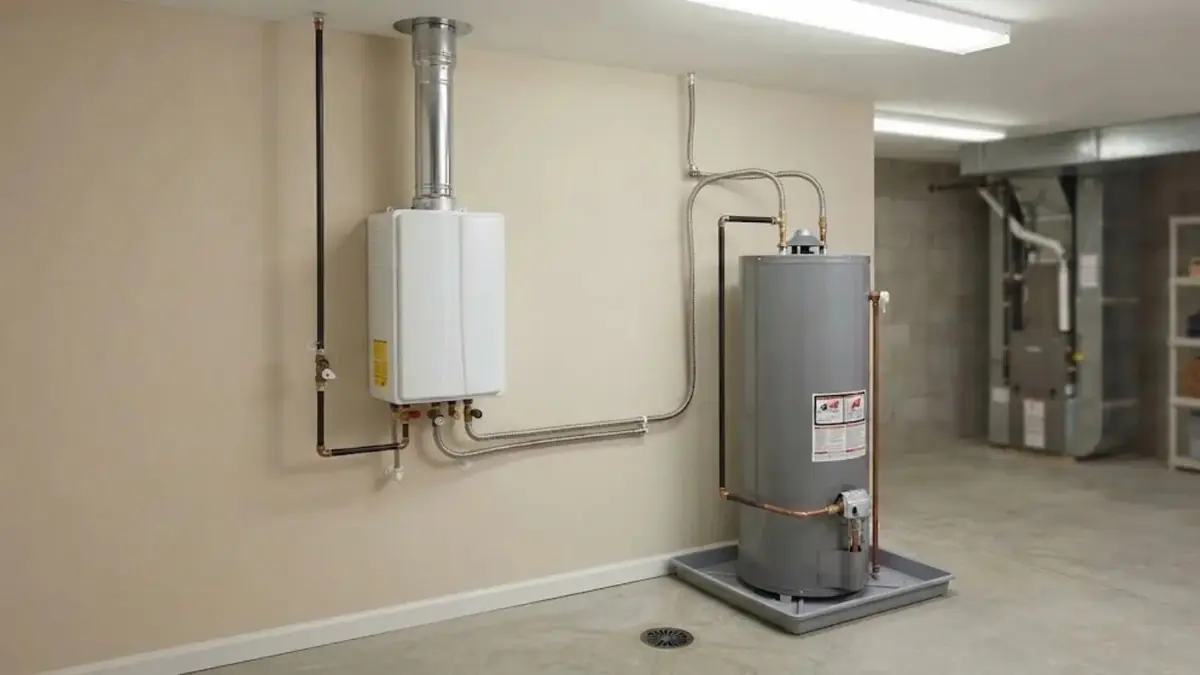
Cold water enters the unit through the inlet. A flow sensor detects that water is moving, and the control board starts the heat source. In a gas unit a burner lights beneath a heat exchanger, and in an electric unit heating elements switch on.
The water passes through the heat exchanger in a few seconds and leaves at the set temperature. When you close the tap, the flow stops, the board shuts off the heat, and the unit goes quiet. Nothing is kept hot in between, which is why there is no standby loss from a big tank.
Gas units also need a way to move exhaust out, usually through a sealed vent or a power vent. Many models have a condensing stage that pulls more heat from the exhaust and produces a small amount of acidic condensate, which needs a drain.
The path of the water, step by step
Here is the sequence inside a typical unit, from the moment you turn on a tap.
Flow starts
A tap opens and water moves through the unit. Most models need a minimum flow before they fire, so a very slow trickle may not trigger heating.
Sensor and board respond
The flow sensor and the inlet temperature sensor report to the control board. The board picks how much heat to apply.
Heat exchanger warms the water
Burner flame or electric elements heat the exchanger. The water gains heat in one pass rather than sitting in a tank.
Outlet sensor checks the result
If the water leaves too cool or too hot, the board adjusts the heat. This is how the unit holds a steady temperature.
Tap closes, unit stops
Flow ends, the heat shuts off, and exhaust or condensate drains away on gas models.
Why flow rate and inlet temperature set your limit
A tankless unit can only raise water temperature by so much at a given flow. Think of it as a fixed amount of heat per minute. Run more gallons through and each gallon gets less of that heat. Start with colder water and you also need more of that heat to reach the same setting.
That is why a unit that handles two showers in August can struggle in January. Indianapolis, the nearest long-term weather station, has a January average low of 20.9 F in the 1991 to 2020 normals, and ground-fed supply water runs colder in that season too. Colder inlet water means less flow at the same set temperature.
A plumber sizes the unit by listing every fixture that could run at once, adding their flow rates, and checking the unit's rating at your winter inlet temperature. Sizing to the coldest season is the safer choice.
Want a licensed plumber to look at it?
Call the 24/7 line and describe what you are seeing.
Tankless and tank, honestly compared
The US Department of Energy lists tankless water heaters at about 20 years, and storage tanks at 10 to 15 years. Lifespan is only one piece of the comparison.
Tankless advantages
- Hot water for as long as the tap runs, within the unit's flow limit
- No standby loss from a tank held hot all day
- Compact and wall-mounted, which frees floor space
- DOE lists about 20 years of life
Tankless trade-offs
- Higher install cost than a tank swap
- Gas models often need larger gas line and new venting
- Output drops when many fixtures run at once
- Yearly descaling in hard water areas
Gas, venting and power are the real project
Many homeowners expect a tankless install to be a simple swap. For a gas unit it often is not. A tankless burner draws more gas at peak than a typical tank, so the existing gas line may need to be larger, and the old flue may not suit a high-efficiency unit.
Electric tankless units pull a lot of power, so the panel, the breaker and the wiring have to carry it. This is a licensed-trade job, and it is why a tankless quote can look so different from a tank quote. Ask what is being changed, not only what is being installed.
Our tankless water heater page explains how we handle these installs. If you are weighing a tank instead, our water heater replacement page covers that path.
Hard water and tankless maintenance
Dissolved minerals come out of hard water when it is heated, and they form scale. In a tank the scale settles on the bottom. In a tankless unit it coats the heat exchanger's narrow passages, which restricts flow and makes the unit work harder.
Most manufacturers call for a periodic flush with a descaling solution, and many units have service valves that make this easy. A water softener can protect the exchanger when the number is high. Read your water utility's annual water quality report to see the hardness number before you choose.
Tankless or not, a quick decision guide
Use this as a starting point, then have a plumber check the details in your house.
| Your situation | Leans toward | Why |
|---|---|---|
| Large family, several showers at once | Large tank or two units | Peak demand can exceed one tankless unit's flow |
| Small household, plan to stay long term | Tankless | Longer expected life and no standby loss |
| Tight space, no room for a tank | Tankless | Wall-mounted units take little floor |
| Old gas line, no easy vent path | Tank or a plan for upgrades | Venting and gas work add to the project |
| Very hard water, no softener | Either, with a softener | Scale harms both, and a tankless exchanger more |
DIY checks and calling for help
Error codes, cold bursts, a rumbling noise or a burning smell from the unit mean it is time to shut off its power or gas valve and call a plumber. If you smell gas, get out of the house, then ring the gas company or 911 from the yard.
You can safely check the filter screen on the inlet, look at the display code against the manual, and run a descaling flush if you have service valves. Anything involving the gas train, venting or wiring belongs with a licensed plumber, and we are available around the clock for urgent faults through our 24/7 emergency line.
What this means in Zionsville
For Indianapolis, the National Weather Service gives a January average low of 20.9 F and a record low of minus 27 F on January 19, 1994. Treat that as a nearby guide for Zionsville, not an exact reading. The practical point is simple. Size a tankless unit for deep-winter inlet water, not the water you see in July.
Citizens Energy Group reports Indianapolis-area water as hard, roughly 200 to 425 ppm, and the Town's utilities page shows Citizens Water phone numbers. That report does not mention Zionsville, so your own bill and your utility's annual water quality report hold your number. If it is high, plan for descaling or a softener.
Zionsville's building permits go through the Town's Planning & Building office, so check with them if a gas line, vent or electrical change comes with your tankless plan. The same winter sizing rule holds in nearby Whitestown and across the rest of our service area.
Frequently asked questions
The unit heats quickly, but the water already sitting in the pipe between the heater and the tap has to be pushed out first. A longer run to a far bathroom means a longer wait, and a recirculation setup can shorten it.
It does not run out like a tank, but it has a flow limit. Run too many fixtures at once and the temperature drops. Proper sizing solves most of this.
DOE puts tankless units at about 20 years against 10 to 15 for storage tanks. Descaling in hard water areas is what keeps it near the top of that range.
Yes, if it is sized for the colder inlet water in January. NWS Indianapolis normals show a January average low of 20.9 F, so ask your plumber for the unit's flow rating at your winter inlet temperature.
Rules depend on the work involved. Check with the Town's building office about any gas, vent or electrical changes before the job starts.
Sources
Figures and guidelines on this page are taken from these public sources. Local rules and utility details can change, so check the source before you rely on a number.
- DOE lifespan: tankless about 20 years, storage tanks 10 to 15 years (Federal agency)
- Indianapolis January average low 20.9 F, 1991-2020 normals (Local government)
- Indianapolis record low minus 27 F on January 19, 1994 (Local government)
- Town utilities page lists Citizens Water contact numbers (Local government)
- Citizens Indianapolis-area water described as hard, about 200 to 425 ppm, report does not name Zionsville (Utility)
- Zionsville Planning & Building reviews building permits (Local government)