
Read the bill before you hunt
Start with gallons, not dollars. Compare the usage figure to the same months last year, because summer watering and a houseful of guests can double use without any leak. Check the billing period length too, and whether the reading was estimated rather than taken from the meter.
A rate change, a new fee or a longer period can raise the total with no extra water at all. If gallons are flat and dollars are up, call the utility's billing office before you spend an afternoon looking for a leak.
The two-hour meter test
The EPA's WaterSense program recommends checking the meter before and after a two-hour period when no water is in use. If the meter reading changes, you probably have a leak.
Stop all water use
Turn off taps, the dishwasher, the washing machine and the ice maker. Make sure nobody flushes a toilet.
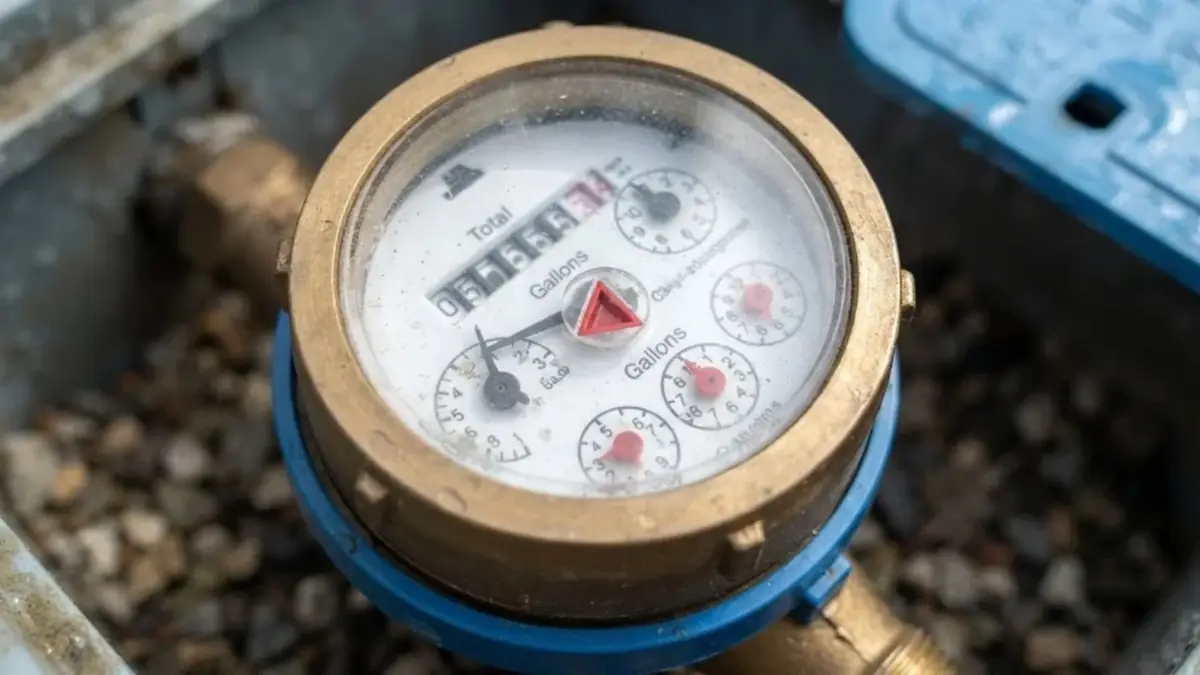
Find and read the meter
It sits in a box near the street or in a basement or utility room. Lift the lid with a screwdriver and note the numbers and the small leak indicator dial or triangle if there is one.
Check the indicator
If the small dial or triangle spins with everything off, water is moving right now. That is a leak signal even before the two hours pass.
Wait two hours
Keep every fixture off. Skip showers, laundry and watering the garden.
Read it again
A changed reading with nothing running means a leak. Write down both readings, the times and the date for your records.
What the meter result tells you
Next, close the main shutoff valve where the water line enters the house and look at the meter again. The result narrows the search.
| What you see | Where the leak likely is | Next step |
|---|---|---|
| Meter moves with the house main closed | Underground line between the meter and the house | Call a plumber for line leak location |
| Meter stops with the main closed, moves when open | Inside the house or at fixtures | Check toilets, then the water heater and softener |
| Meter does not move in two hours | No leak at that moment | Look at habits, irrigation, billing period or meter accuracy |
| Meter moves only at certain times | Irrigation, a softener cycle or a toilet filling now and then | Time the movement against your schedule |
The Indiana Office of Utility Consumer Counselor (OUCC) notes that an unusually high bill can come from a leak in the underground supply line. That line is typically the customer's job to fix between the meter and the building.
Want a licensed plumber to look at it?
Call the 24/7 line and describe what you are seeing.
Where a hidden leak usually lives
Most hidden household water loss comes from a short list of suspects. Check them in this order.
A toilet flapper
A worn flapper lets water trickle from the tank into the bowl all day with no sound you would notice.
A dripping faucet
At one drip per second, OUCC puts the loss near 260 gallons a month.
The underground line
A pinhole in the pipe from meter to house can run for months under the lawn with nothing showing.
An irrigation system
A stuck zone valve or a broken head can run when the controller says it is off.
A water heater relief valve
A weeping relief valve drips into a discharge pipe where you may never see it.
A softener or humidifier line
A drain line that keeps cycling sends water straight down the floor drain.
Two toilet tests worth doing today
Toilets are the most common cause, and the test takes minutes.
- Food coloring test Put a few drops in the tank and do not flush. EPA says color in the bowl after 10 minutes means the flapper leaks. OUCC suggests 15 to 20 minutes, so waiting the longer time is safer.
- Flush afterward Flush right after the test so the dye does not stain the bowl.
- Listen at night A toilet that hisses or refills on its own in a quiet house is leaking from the tank.
How big a leak is a big leak?
For scale, EPA data shows a typical home loses upward of 9,300 gallons a year to leaks. Roughly one house in eleven loses 50 gallons a day or more. In winter, a four-person household that runs past 12,000 gallons in a month should suspect a serious leak.
Those are national figures, not Zionsville averages, so use them only as a yardstick for your own bill. EPA adds that repairing the easy leaks can trim about 10 percent from a water bill.
Shut it off if you find water moving
If the meter proves a leak and you suspect the underground line, close the main shutoff valve inside the house. That stops water at the building, and you can call a plumber without more loss. Open one faucet afterward to relieve pressure.
Dripping water near the electrical panel or an outlet is a safety issue. Stay clear and shut off power at the breaker only if you can reach it dry. Photograph meter readings, wet areas and receipts for your insurance file.
DIY checks versus calling in help
Plenty of the work is safe for a homeowner. The line from the meter to the house is where professional gear matters.
You can do
- Read the bill and compare gallons by month
- Run the two-hour meter test
- Dye test every toilet
- Check faucets, hoses and the relief valve discharge
- Time irrigation and softener cycles
Call a licensed plumber for
- Leaks on the line from meter to house
- Leaks inside walls or under a slab
- A meter that moves with the main closed
- Wet floors or ceilings with no known source
- Any repair that needs the main valve replaced
How we find a leak you cannot see
A plumber starts with the same meter test, then isolates sections by closing valves. Acoustic listening gear picks up the hiss of pressurized water in a pipe, and a pressure test shows whether a line holds. Our water line repair page covers what happens after the leak is found.
If the pipes hold pressure and the meter keeps running, we say so. The next call then goes to the utility, and the meter test section of this page tells you how to ask.
What this means in Zionsville
Sewer service in Zionsville comes from the Town, which bills a flat monthly rate for each residence. If that is the sewer charge on your bill, a jump in the total traces to the water side, so compare gallons month to month instead of the dollar total.
The Town's Trash and Utilities page lists Citizens Water contact numbers, and its Residents page points to a wastewater billing office. Your bill names your own water utility. Call that office for meter reading history.
Ask about meter testing, too. A state rule, 170 IAC 1-12, lets customers of Indiana Utility Regulatory Commission regulated utilities apply for a meter test. The rule also bars the utility from discarding the meter first without written consent. We have not confirmed that it covers every utility, so ask yours.
Serving nearby towns
We help homeowners in Whitestown and Zionsville with meter and line leaks. The rest of our service areas are listed for towns outside those two.
Frequently asked questions
Shut off every fixture and appliance, read the meter, and read it again after two hours with no water used. EPA says a changed reading probably means a leak. Close the main valve and look again to tell yard leaks from indoor ones.
The Indiana OUCC says the underground supply line is typically the customer's responsibility from the meter to the building. Details can differ by utility, so ask your utility's billing office.
Ask the utility named on your bill. Indiana rule 170 IAC 1-12 lets customers of Indiana Utility Regulatory Commission regulated utilities apply for a test, but we have not confirmed it reaches every utility.
Check the billing period, estimated readings, irrigation, guests, a new appliance or a rate change. A meter that reads fast is possible but less common than a toilet or irrigation leak, so do the meter test first.
OUCC puts a drip per second at roughly 260 gallons a month. A worn washer or cartridge is a small repair next to that.
Many policies cover sudden, accidental damage and not slow leaks or the worn part. Read your policy and ask your agent before filing.
Sources
Figures and guidelines on this page are taken from these public sources. Local rules and utility details can change, so check the source before you rely on a number.
- EPA WaterSense Fix a Leak: two-hour meter test, 9,300 gallons, 9 percent of homes, 12,000 gallons, 10 percent savings, food coloring test (FACTS.md) (Federal agency)
- OUCC: high bill and underground line responsibility, 260 gallons per month drip, toilet dye test 15-20 minutes (Agency)
- Town sewer service, flat monthly rate per residence, Citizens Water contact numbers listed (Local government)
- Wastewater billing office listed on Residents page (Local government)
- 170 IAC 1-12 meter test on customer application, utility may not discard meter before test (Justia copy of the Indiana Administrative Code, secondary) (code body)