
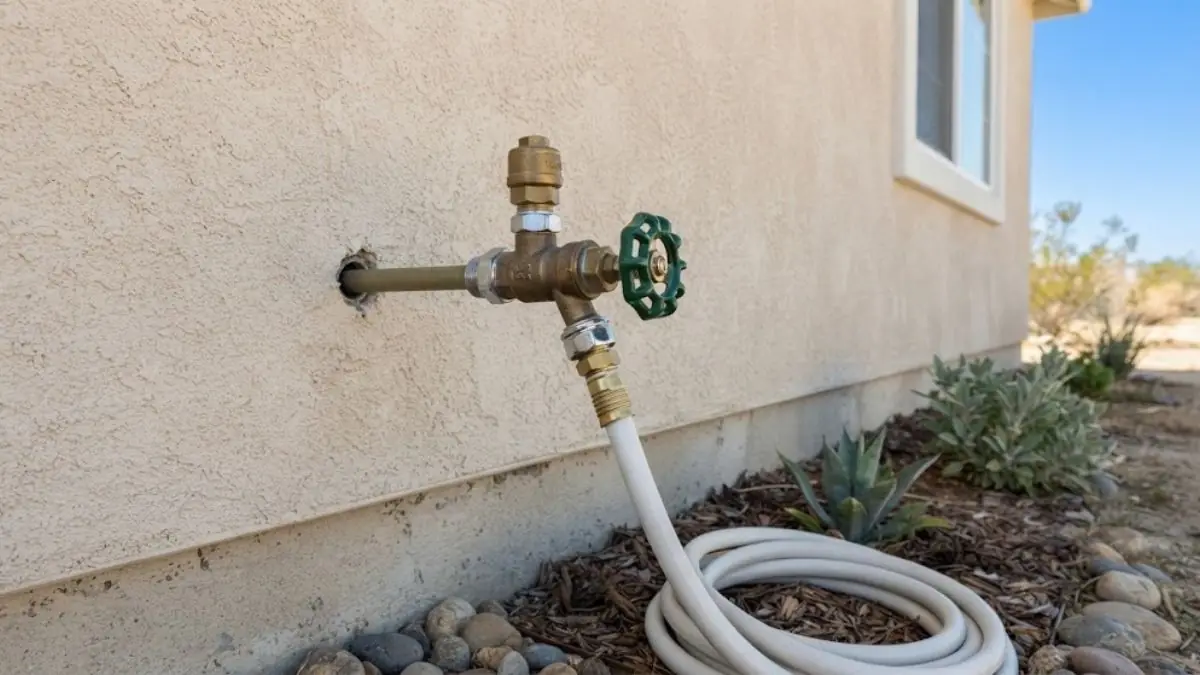
Where is the water coming from?
Dry the spigot with a rag, open it and close it, then watch for the first bead of water.
Drips from the spout when closed
The washer or seat inside the valve no longer seals. This is the most common outdoor faucet drip.
Leaks around the handle
The packing nut or packing washer behind the handle has worn. Water squeezes up the stem when the faucet is on.
Sprays at the hose connection
The hose washer is missing, hard or flat, or the threads on the spigot are worn.
Leaks where the pipe meets the wall
A cracked pipe or fitting, often from a past freeze. Treat this as a more serious leak.
Water inside the wall or basement
A damp rim joist, a wet drywall patch or dripping near the basement ceiling can point to a split pipe behind the spigot.
Handle turns but no flow
The stem is stripped or the washer is detached. The fix is a new stem or a new faucet.
Why a hose left on can break the pipe
Most modern outdoor spigots are frost-free, meaning the valve seat sits several inches inside the heated wall so the part that can freeze is drained. That design only works if the water can run out. A hose left attached traps water in the barrel, and ice can split it.
The split is often hidden. In winter the ice plugs the crack. In spring the thaw lets water flow, and the leak runs inside the wall whenever you open the faucet. That is why a spigot that was fine in fall can soak the wall in May.
Fix a dripping spout or leaking handle
Use this for a standard compression or frost-free hose bib. Shut off the water to the line first if there is an interior shutoff valve, then open the spigot to drain it.
Close the water supply
Find the interior shutoff for the outdoor line, often near the basement ceiling, and turn it off. Open the spigot to drain the pipe.
Remove the handle and packing nut
Take off the handle screw and handle, then loosen the packing nut with an adjustable wrench. Note the order of the parts.
Replace the packing washer
If the leak is at the handle, a new packing washer or a wrap of graphite packing string under the nut usually stops it.
Replace the stem washer
If the spout drips, pull the stem and swap the rubber washer at the end. Match the shape and size to the old one.
Reassemble and test
Tighten the nut snug, turn the water on slowly, and check the handle, the spout and the wall for water.
Want a licensed plumber to look at it?
Call the 24/7 line and describe what you are seeing.
Repair the spigot or replace it
A cheap washer fix is not always the right one.
Repair when
- The leak is at the handle or spout only
- The body and threads look sound
- Parts match the model
- It is a standard hose bib in good shape
Replace when
- The body is cracked or the threads are stripped
- Water appears inside the wall or basement
- The faucet is not frost-free and has frozen before
- Parts are no longer made
Winterize every outdoor faucet
State consumer guidance from the OUCC starts with the hose. Unhook every outdoor hose before the cold arrives, then wrap exposed pipe in unheated spaces and learn where the main shutoff is. Each step costs little, and the hose is the one most often forgotten.
For a spigot, remove the hose, drain the line from the interior shutoff if you have one, and then open the outdoor faucet to let the barrel empty. A foam faucet cover helps in a hard freeze, but it does not replace removing the hose.
Repair it yourself or call us
Call right away if water runs inside the house when the outdoor faucet is on, if the wall or ceiling near the spigot is wet, or if the faucet will not shut off. Close the main water shutoff, which is usually where the line enters the house, and call.
Washer and packing jobs are good DIY work with the water off. Cutting into the wall, sweating copper, or tracing a hidden leak is plumbing work. Our faucet repair service covers spigots, and a burst pipe repair call is the right one when a frozen line has split.
What this means in Zionsville
The National Weather Service office for Indianapolis puts the average first freeze on October 26 and the average last freeze on April 17. Those are Indianapolis dates, a nearby guide and not a Zionsville reading. In practice, hoses come off in the second half of October, before the first hard frost.
January lows average 20.9 F there, and the record is minus 27 F, set on January 19, 1994. A frost-free spigot copes with ordinary cold when it can drain, but a hose left on in a deep freeze is the failure to avoid.
If a pipe does freeze, close the main valve right away and call a licensed plumber. Never thaw it with a torch or open flame. Once it is thawed, open the water slowly and watch for leaks. The OUCC gives the same advice. We also work in nearby Whitestown, and our service area page lists the rest.
Frequently asked questions
Water is finding a path past a worn hose washer or around damaged threads. A new rubber hose washer is a cheap first fix. If the leak is behind the handle, the packing is worn.
Yes. Use the interior shutoff for the outdoor line if there is one, or the main shutoff if not, then open the spigot to drain the pipe before you take anything apart.
NWS Indianapolis lists an average first freeze of October 26. The nearest long-term station is Indianapolis, so use that as a guide and disconnect hoses before then, not after the first cold night.
Open it in spring and watch the wall, ceiling and basement near it. Water running inside, a wet rim joist or a drop in pressure with the faucet on is a sign of a split pipe, and you should close the shutoff and call.
It wastes water, and a drip can freeze into a larger problem. EPA WaterSense names dripping faucets among common household leaks, so a quick repair is worth it.
Sources
Figures and guidelines on this page are taken from these public sources. Local rules and utility details can change, so check the source before you rely on a number.
- NWS Indianapolis average first freeze October 26, last freeze April 17, record low (Local government)
- Indianapolis January average low 20.9 F, 1991-2020 (Local government)
- Indianapolis record low minus 27 F on January 19, 1994 (Local government)
- OUCC: disconnect hoses, insulate pipes, find main shutoff, shut main, call licensed plumber, no open flame, reopen slowly (Agency)
- EPA WaterSense: dripping faucets as a common leak (Federal agency)